How Taraweeh united the world for over 1,400 years
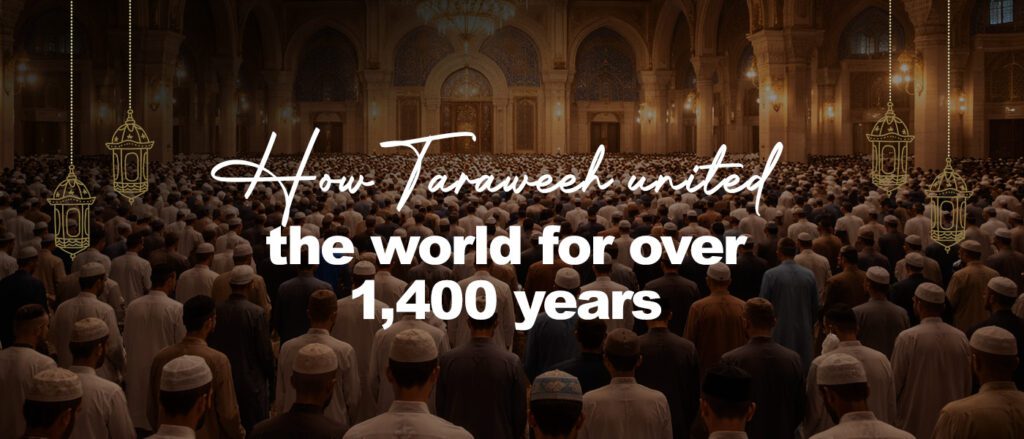
During this blessed month of spiritual cleansing, repentance, and steadfastness, consider making a donation towards our efforts in serving The Quran so that every individual, Muslim and non-Muslim, is able to connect with Allah (SWT) during His month. Whether it’s a one-time donation or Sadaqah Jariyah, no investment is small in the view of Allah (SWT) in the month of The Quran. Join us live each night for Taraweeh from Masjid Furqaan Bolingbrook on Facebook and YouTube. If you cannot be with us in person, stay connected from wherever you are and let the recitation of The Quran fill your home with the spirit of Ramadan. Tune in, share with family and friends, and be part of a community that stands together in prayer, reflection, and mercy every single night. In the collective memory of the Muslim Ummah, few acts of worship hold such a profound place during the month of Ramadan such as Salat al-Taraweeh. For many, it is the spiritual routine of the month where every night, you immerse yourself in The Quran in an extended night of worship with the Divine, marking it both a social and devotional encounter. Yet beyond its familiarity lies a rich and complex history, spanning from the earliest days of revelation to the lived Sunnah of the Prophet (SAW), the ijtihad of the rightly guided Caliphs, and the ongoing negotiations between legal precedent and spiritual experience. To explore the history of Taraweeh is to explore how early Muslims lived revelation, interpreted prophetic examples, and responded, with deep care, to the balance between form and essence in worship. The very concept of night prayer, qiyam al-layl, predates Taraweeh as we know it. It is foundational to The Quranic vision of spiritual refinement and nearness to Allah (SWT). In fact, one of the earliest commands revealed to the Prophet (SAW) came in the form of an injunction to pray during the night. The beginning of Surah Al-Muzammil, widely acknowledged as among the earliest revelations chronologically, opens with the address, “O you, wrapped in your clothes! Stand all night in prayer except a little—pray half the night, or a little less, or a little more—and recite the Quran properly in a measured way.” (The Clear Quran®, 73:1-4) This command, according to the early mufassirun, was initially obligatory upon the Prophet (SAW) and a small group of believers who followed him. The purpose of this rigorous nightly standing was not merely devotion in the abstract, but preparation, for what the verse calls a “weighty word” to be revealed. The night, described as ashaddu wat’an and aqwamu qilan was thus chosen by Allah (SWT) as the terrain upon which the soul of the Prophet (SAW) would be shaped by revelation. This form of night worship was not limited to Ramadan. It was a regular, year-round discipline, and the Prophet (SAW) continued it throughout his life, even after it was no longer mandated for the believers. In a well-known hadith, Lady Ayesha bint Abu Bakr (RA) relates that the Prophet (SAW) would stand for countless hours in the night to the extent that his feet would swell, and when she asked him why he (SAW) exerted himself so much when his past and future sins had already been forgiven, he (SAW) replied, “Should I not be a grateful servant?” (Sahih Bukhari) Yet it is in the month of Ramadan that this standing takes on a unique and intensified character. The Quran describes Ramadan as the month in which the revelation first descended, “Ramadan is the month in which the Quran was revealed as a guide for humanity with clear proofs of guidance and the decisive authority.” (The Clear Quran®, 2:185) And we know that, each year, the Prophet (SAW) would review The Quran with Jibraeel (AS) during Ramadan. In the final year of his life, this review was done twice, according to Sahih Bukhari. This practice of deep Quranic immersion in the nights of Ramadan formed the spiritual backdrop to what would become Taraweeh, an extended, communal form of qiyam al-layl specific to this sacred month. The word Taraweeh itself is not used in The Quran or the early hadith as its original term. Linguistically, it is the plural of tarawihah, and this is derived from the root ر-و-ح which carries meanings of rest, ease, and comfort. Early Muslims would take brief pauses after every four rakat due to the length of the prayer, and so this term came to refer to the entire practice, not merely as a technical label, but as a spiritual description of what the prayer offered: rest for the soul through communion with The Quran. During the lifetime of the Prophet (SAW), Taraweeh was practiced, but not institutionalized. Its form was spontaneous, its gathering organic, and its performance marked by both presence and caution. One of the clearest narrations in this regard comes from Lady Ayesha bint Abu Bakr (RA) who recounts, “The Messenger of Allah prayed in the mosque one night, and people followed him in prayer. Then he prayed the next night, and more people gathered. Then on the third or fourth night, the mosque was full, and the Messenger of Allah did not come out to them. In the morning, he said, ‘Nothing prevented me from coming out to you except that I feared that it would be made obligatory upon you.’” (Sahih Bukhari) This narration is critical in understanding both the mercy of the Prophet (SAW) and the deliberate restraint with which he introduced devotional practices. His withdrawal from leading Taraweeh, despite its clear benefit, was rooted in his prophetic concern that the Ummah not be overburdened. This concern is consistent with Allah’s (SWT) broader message, “Strive for the cause of Allah in the way He deserves, for it is He who has chosen you, and laid upon you no hardship in the religion—the way of your forefather Abraham.” (The Clear Quran®, 22:78) Thus, while Taraweeh in congregation was performed during his lifetime, it remained a non-obligatory, non-institutionalized Sunnah. Following the Prophet’s (SAW) departure, this pattern continued during the caliphate of Abu Bakr as-Siddiq (RA). The Ummah was still in a state of mourning and early consolidation. The Quran was being collected, false prophets were being dealt with, and the spirit of worship remained focused on what was known and established. Taraweeh remained practiced, but as
If not Ramadan, then when? The importance of interfaith engagement in the month of The Quran
During this blessed month of spiritual cleansing, repentance, and steadfastness, consider making a donation towards our efforts in serving The Quran so that every individual, Muslim and non-Muslim, is able to connect with Allah (SWT) during His month. Whether it’s a one-time donation or Sadaqah Jariyah, no investment is small in the view of Allah (SWT) in the month of The Quran. Each year, as the crescent moon of Ramadan reappears in the night sky, it carries with it a significant spiritual peace that transforms the lives of nearly two billion Muslims across the globe. The shift is almost immediate. The fast-paced noise of life slows down. The heart begins to soften, and our calendars reorient around the times of suhoor and iftar, our tongues remember The Quran, and our hearts yearn for the blessings and great rewards that come with Laylat al-Qadr, the most anticipated nights of the year. In many ways, Ramadan becomes a spiritual awakening and cleansing where we are forced to take a pause from the things that interrupt us in becoming closer to Allah (SWT), and where we recenter our souls on what truly matters which is our relationship with our Lord, our duties to others, and our responsibility as stewards of truth, mercy, and justice on earth. While the internal transformation of that believer is at the heart of Ramadan’s power, it would be a profound oversight to think that the spirit of Ramadan ends at the threshold of the masjid or the walls of our homes. Ramadan is not only an intensely personal journey, it is also an intensely communal one. It is a time when Muslim communities open their doors, host iftar meals, run food banks, invite neighbors, give more to charity, and engage more visibly with the world around them. There is a particular noor that emanates from Muslims during this month, and in a time when the global community continues to grapple with religious tension, mutual suspicion, and cultural divides, that light offers something invaluable, and that is the chance to build meaningful interfaith bridges. This may not be the first thing Muslims think of when the word “Ramadan” is mentioned. After all, the month is primarily about our submission to Allah (SWT) through fasting, prayer, charity, and reflection. However, in light of The Quran’s message and the blueprint of our Prophet (SAW), it becomes evident that one of the most overlooked gifts of Ramadan is its potential to open hearts, not only among Muslims, but also between Muslims and their non-Muslim neighbors, colleagues, classmates, and fellow citizens. The intense spirituality of the month has the power to soften not just our own hearts, but to disarm the suspicions and misunderstandings that so often plague perceptions of Islam. This is not a modern idea or a Western social project. It is deeply rooted in our tradition. The Quran presents humanity as a diverse creation of Allah (SWT), and that diversity is not something to be erased or feared, it is something to be understood. Allah (SWT) says, “O humanity! Indeed, We created you from a male and a female, and made you into peoples and tribes so that you may get to know one another. Surely the most noble of you in the sight of Allah is the most righteous among you. Allah is truly All-Knowing, All-Aware.” (The Clear Quran®, 49:13) This verse is not limited to Muslims. Allah (SWT) has not explicitly just mentioned Muslims here. It addresses all of humanity, and that our differences in language, ethnicity, and religion are part of the divine design of Allah (SWT). As a result, we cannot look at Ramadan as just a month of abstinence. It becomes a platform for human connection, for spiritual witness, and for demonstrating, through both words and deeds, the beauty of Islam in its most sincere and authentic form. Around the world, statistics show that the visibility of Muslims increases dramatically during Ramadan. Whether it’s through public iftar events, charitable campaigns, or news coverage, the month offers a unique window in which non-Muslims actively engage with Muslim communities, often for the first time. According to a 2017 report from the Pew Research Center, How the U.S. general public views Muslims and Islam, approximately 69% of Americans admit that Muslims face more discrimination than blacks (59%) and Hispanics (56%). Further, a total of 53% of Americans believe that the representation of Muslims in the media is unfair to them. This gap between what is seen on a screen and what is experienced when you actually meet a Muslim creates a critical challenge (in 2016, 41% of Americans said Islam is more likely to encourage violence). Ramadan, then, becomes a great opportunity for dawah for both adults and, especially, the youth. However, this work cannot remain external. When Muslims engage in interfaith efforts during Ramadan, something remarkable happens. We are forced to reflect more deeply on the universality of our values. We begin to articulate our beliefs more clearly. We develop patience, wisdom, and understanding. Our compassion expands, and in doing so, we fulfill one of the core missions of the Prophet (SAW) himself, and that is to be a mercy to all the worlds. “We have sent you O Prophet only as a mercy for the whole world.” (The Clear Quran®, 21:107) In the following article, we will explore The Quranic basis for interfaith engagement in Islam, examine the unique spiritual and social power of Ramadan in facilitating these efforts, and share examples from history and the modern world where Muslim communities have used Ramadan to build bonds across the boundaries of faith. We will also look at practical strategies for how Muslims today can thoughtfully, respectfully, and confidently engage in interfaith dialogue during the month of Ramadan without compromising our values. The qualities of Ramadan that make it the best month for interfaith efforts In every human being, there is a heart that can either draw closer to the truth or turn away from it, and the nature of the heart is that it changes, it is not in the same state all the time. Just as the seasons affect
Fasting and formation: The political and spiritual impact of Ramadan
During this blessed month of spiritual cleansing, repentance, and steadfastness, consider making a donation towards our efforts in serving The Quran so that every individual, Muslim and non-Muslim, is able to connect with Allah (SWT) during His month. Whether it’s a one-time donation or Sadaqah Jariyah, no investment is small in the view of Allah (SWT) in the month of The Quran. Ramadan, in the minds of many today, occupies a place primarily within the realm of individual spirituality where it’s a month associated with fasting, prayer, charity, and recitation of The Quran. However, such a reductionist view, while not incorrect in its emotional and devotional core, fails to account for the deeper historical, political, and civilizational role this sacred month has played in shaping the Muslim Ummah as a moral community, a repository of revealed guidance, and a bearer of spiritual and intellectual vision. To fully appreciate what Ramadan has meant for Muslim societies across centuries, we must lift our gaze beyond the familiar rituals that animate the personal lives of believers and instead situate this month within the broader context of Islamic civilization. A story that is marked by the descent of revelation, the formation of just societies, the confrontation with tyranny, and the renewal of communal identity. It is not an exaggeration to say that Ramadan has served, time and again, as the calendar of awakening, a moment in the yearly rhythm of Islamic life when the hearts of believers and the conscience of entire communities have been reoriented toward divine purpose. Its influence is not limited to the inner state of the fasting individual, but rather extends into the collective psyche, ethical norms, intellectual productivity, and even the political mobilization of the Muslim world. In the article below, we will explore how Ramadan has functioned as a historical actor and civilizational force, breathing life into empires and reform movements, anchoring the Ummah through both crisis and triumph, and offering not only spiritual salvation but cultural cohesion and moral clarity. Ramadan as the engine of civilizational consciousness Any discussion about Ramadan’s historical and civilizational weight must begin not with its dietary restrictions or nightly rituals, but with the foundational reality that it is the month of Quranic revelation, an event that altered not merely the spiritual trajectories of individuals, but the moral and intellectual course of human civilization itself. Allah (SWT) says, “Ramadan is the month in which The Quran was revealed as a guide for humanity with clear proofs of guidance and the decisive authority […].” (The Clear Quran®, 2:185) The Quran’s descent in Ramadan marks the point of departure between jahiliyyah and a new era of divine clarity, where revelation began to reconfigure not only how people prayed or fasted, but how they governed, traded, judged, and lived together as a society grounded in divine justice. In this sense, Ramadan inaugurated a civilizational paradigm where scripture shaped law, ethics, education, social relations, and global vision. The early Muslim community, particularly the generation of the Prophet (SAW) and the Sahabah, internalized this fusion between divine revelation and worldly reform, approaching Ramadan not as a temporary retreat from civic life, but as a moment to immerse in the scriptural source of their collective identity, readying themselves for both spiritual refinement and historical responsibility. Moments that shaped history in the month of Ramadan Across the centuries, Ramadan has not merely coincided with important historical events, rather, it has actively shaped the mental and moral landscape in which those events took place. Time and again, Ramadan has witnessed not just acts of devotion, but pivotal moments of confrontation, resistance, conquest, and renewal, reminding the Ummah that the sacred is never divorced from the worldly when the latter is guided by divine light. The Battle of Badr: On the 17th of Ramadan, in the second year after Hijrah, the Muslim Ummah faced its first existential threat in the form of the Qurayshi army at Badr. Despite being outnumbered and under-equipped, the believers achieved a victory that was not merely military, but moral and symbolic, a validation of the truth of the Prophet’s (SAW) mission, and a declaration that tawheed was no longer confined to private belief, but now had a public and political presence in the Arabian peninsula. Allah (SWT) said in The Quran, “Indeed, Allah made you victorious at Badr when you were vastly outnumbered. So be mindful of Allah, perhaps you will be grateful.” (The Clear Quran®, 3:123) The fact that this confrontation occurred in Ramadan is not incidental. It is a reflection of how fasting, heightened consciousness, and Quranic immersion can give rise to courage, sacrifice, and transcendent commitment. The Conquest of Makkah: When the Prophet (SAW) re-entered Makkah during Ramadan eight years after Hijrah, he did so not with vengeance, but with humility and mercy, declaring general amnesty and restoring the Ka’bah to its monotheistic purpose. This moment presents a civilizational maturity, where Islamic leadership was not defined by tribal retaliation or military glory, but by spiritual authority, forgiveness, and institutional reform. Allah (SWT) has said, “And declare, ‘The truth has come and falsehood has vanished. Indeed, falsehood is bound to vanish.” (The Clear Quran®, 17:81) The conquest was as much about restoring civilizational order as it was about reclaiming territory, and Ramadan offered the ideal spiritual context for such a transformative moment. The Battle of ‘Ayn Jalut: This was a battle in which the Mamluks halted the seemingly unstoppable Mongol advance, also occurred in Ramadan, demonstrating again how this month has historically brought out not only personal piety but communal resilience and institutional revival. Even in modern times, Ramadan has often coincided with revolutions, resistance movements, and ideological awakenings, serving as a reminder that The Quran’s transformative power is never limited to the page or the heart, it inevitably flows into the world, challenging tyranny and uplifting those who bear witness to truth. Ramadan’s impact on public morality and culture Ramadan, as practiced across Muslim lands, does more than inspire individual taqwa, it initiates an annual moral recalibration of society, temporarily reshaping economic rhythms, media content, public behavior, and community life in ways that
A prayerless life: What we lose when we stop turning to Allah (SWT)
There is a kind of forgetting that happens so slowly, so quietly, that a person doesn’t even realize it has taken place until much later. It doesn’t announce itself. It doesn’t knock the door down. It simply withdraws, day by day, until one morning, a person wakes up and finds that something central to their life is gone, not stolen but neglected. This is the story of how salaah, the most fundamental act of worship in Islam, disappears from a Muslim’s life. Not always from rebellion, not always from disbelief, but often from simple disengagement. A few missed prayers turn into a pattern. The pattern becomes a norm and, eventually, the limbs forget what it means to bow, the tongue forgets the words of Allah (SWT), and the heart forgets the One it was created to remember. Salaah is not just one of the five pillars of Islam, it is the pillar that holds up everything else. The Prophet (SAW) said, “The first matter that the slave will be brought to account for on the Day of Judgment is the prayer. If it is sound, then the rest of his deeds will be sound, and if it is corrupt, then the rest of his deeds will be corrupt.” (Sunan at-Tirmidhi) This single act of worship is not merely a ritual obligation among many, but the very measure by which the health of one’s entire spiritual life is determined. When prayer is intact, everything else may find its place. However, when prayer is abandoned, even the good in a person’s life begins to unravel. The outer self might carry on, but the inner self is untethered, directionless, unanchored, and vulnerable to forces the person may not even recognize. This is not a theory. It is a lived reality for countless Muslims around the world. From university students navigating secular environments, to professionals overwhelmed by fast-paced careers, to entire families drifting from their religious roots, the decline of prayer is not isolated. It is systemic, and while much attention is given to societal pressures, ideological confusion, and cultural shifts, less attention is paid to the spiritual cost of removing salaah from one’s life. What happens to a person’s sense of purpose, their moral compass, their resilience in hardship, and their relationship with the unseen when they no longer bow five times a day? What happens to their identity as a Muslim when the single most visible, most essential act of faith is no longer practiced? The Quran speaks of this with sobering clarity. In describing the generations that came after the prophets, Allah (SWT) says, “But they were succeeded by generations who neglected prayer and followed their lusts and so will soon face the evil consequences.” (The Clear Quran®, 19:59) This verse doesn’t mention abandoning religion entirely. It begins with the neglect of prayer. That neglect leads to the pursuit of desires, a life lived with no higher reference point, and that path, Allah (SWT) warns, leads to spiritual ruin. Notice how the verse connects the inner and outer world—the failure to pray doesn’t stay confined to private worship. It shapes the way a person lives. It opens the door to impulses taking over, to the self becoming the sole guide, to the disintegration of taqwa in everyday choices and, once that happens, a person may still call her/himself Muslim, but the light that once connected them to their Lord begins to fade. What makes this even more serious is that salaah is not just a duty, it is a gift. It is a Divine interruption in the chaos of the day. It is a chance to pause, to remember, and to realign. It is an act that transforms. The Prophet (SAW) compared it to bathing five times a day. He said, “If there was a river at the door of one of you in which he bathes five times a day, would any of his dirt remain?” The people replied, “Nothing of his dirt would remain.” He said, “That is the example of the five prayers by which Allah removes sins.” (Sahih Bukhari) Imagine a person who slowly stops bathing, not because they enjoy filth, but because they become numb to its presence. Eventually, they forget what it feels like to be clean. This is the state of the one who abandons prayer that not only are their sins no longer being washed, but they lose the ability to even sense the spiritual dirt accumulating on their soul. This article does not seek to point fingers or condemn. Rather, it is an attempt to look honestly, and courageously, at the spiritual consequences of a prayerless life. It is written for the countless Muslims who, for one reason or another, have left salaah behind. Some did so out of laziness, others out of doubt, others because life overwhelmed them. Whatever the reason, the result is the same: a widening distance between the servant and the Master and – with that distance – confusion, sadness, instability, and loss. We will explore these consequences in detail, spiritually, psychologically, and even communally. However, more importantly, we will also ask ourselves, is there a way back? Can a person who has stopped praying find their way to khushu again? Can the heart, long neglected, be made soft in front of Allah (SWT)? To answer these questions, we begin first by understanding what salaah truly means. Not just its technical definition, but its place in the architecture of a Muslim’s life because only when we understand what has been lost can we fully grasp what it means to return. The spiritual structure of Salaah, and what collapses without it To truly grasp what is lost when salaah is removed from a person’s life, one must begin by understanding what salaah is meant to build. It is not a mere ritual, nor a symbolic act of religious affiliation. It is the spine of the spiritual self, the structure upon which the entire relationship between the servant and his Lord rests. It is no coincidence that among the five pillars of Islam, only salaah is mandated five times a day. Hajj is once in
3 lights of guidance: how Islam shapes us to recognize haq
Across the Muslim world, we are witnessing a strange paradox. On the one hand, Islamic knowledge is more accessible than ever before. Books, lectures, fatawa, and scholarly institutions are within reach of millions. Young people memorize The Quran, study ahadith, and engage in religious discourse at a level unmatched by previous generations. On the other hand, confusion continues to spread and misapplications of Islamic rulings appear both online and in real life. Scholars are challenged not on the basis of principle, but personality. Communities fracture over shallow differences, and the result is a growing uncertainty: if knowledge is so widespread, why does the truth still feel out of reach? The answer lies not in the failure of ilm itself, but in the absence of its two companions, hikmah and basirah. While ilm provides the content of truth, its sources, rulings, and evidence, hikmah is what enables a person to apply that truth correctly, proportionately, and in real-life situations. Deeper still, basirah is the internal clarity that allows one to perceive truth when it is buried under ambiguity, falsehood, or fitnah. Without this triad working together, even the most learned individuals can go astray, and communities may be led by the well-informed but misdirected. In The Quran, Allah (SWT) frequently distinguishes between these three traits. Knowledge is praised when it is linked with reverence and action. Wisdom is granted as a divine gift to the prophets and those grounded in guidance. Basirah is described as the basis of the Prophet’s (SAW) dawah itself, “Say, O Prophet, ‘This is my way. I invite to Allah with insight—I and those who follow me. Glory be to Allah, and I am not one of the polytheists.” (The Clear Quran®, 12:108) These are not overlapping words. They are distinct epistemological tools (ways of knowing, applying, and perceiving the truth), each playing a unique role in how Islam envisions human beings to function as moral and spiritual agents. This article will explain each of these concepts, ilm, hikmah, and basirah, in detail. It will explore how The Quran and Sunnah use these terms, how classical scholars defined and distinguished them, and how their presence, or absence, affects Muslim thought, leadership, and public life today. It is not simply a theological reflection, but a practical one because the Ummah’s revival does not lie in multiplying information alone, but in restoring the full architecture of guidance—knowledge that is rightly applied, insight that is spiritually anchored, and truth that is lived with humility and clarity. Ilm is the foundation of knowing The Arabic word ilm appears in The Quran in over 750 different forms. This shows how deeply embedded it is in the way Islam shapes belief, law, ethics, and human understanding. At its core, ilm refers to gaining reliable and truthful understanding – an awareness that reflects reality and is supported by sound evidence. In Islamic scholarship, this could come through transmitted sources, naqli, such as The Quran and Sunnah, or through rational reflection, ‘aqli, such as careful reasoning and observation. Importantly, classical Muslim scholars did not treat ilm as neutral or equally valuable in every form. Instead, they classified it according to where it came from, what it was about, and what impact it had. The most important kind of knowledge that came from revelation because this was the knowledge of Allah (SWT), His names and attributes, His guidance, and the realities of the afterlife. This kind of knowledge was always given the highest importance. Scholars such as al-Ghazali, Fakhr al-Din al-Razi, and ibn Khaldun made clear distinctions between religious knowledge, ulum diniyah, and worldly or practical knowledge, ulum dunyawiyah. They did not see the two as opposed to one another, but they prioritized the former because it dealt directly with the soul and the purpose of life: salvation. This distinction was never about rejecting useful knowledge of the world, but about putting what affects the Hereafter above what only serves this life. The Quran describes ilm not just as knowing something, but as a gift from Allah (SWT) and a moral responsibility. In one verse, Allah (SWT) tells us what people in Hellfire will say, “And they will lament, ‘If only we had listened and reasoned, we would not be among the residents of the Blaze!’” (The Clear Quran®. 67:10) This verse makes it clear that not using one’s mind, or not seeking the right kind of knowledge, can lead to loss in the Hereafter. In another verse, Allah (SWT) says, “˹Are they better˺ or those who worship ˹their Lord˺ devoutly in the hours of the night, prostrating and standing, fearing the Hereafter and hoping for the mercy of their Lord? Say, ˹O Prophet,˺ “Are those who know equal to those who do not know?” None will be mindful ˹of this˺ except people of reason.” (The Clear Quran®, 39:9) The answer is obvious: they are not equal. However, The Quran does not define knowledge by degrees or formal education. Instead, it connects true knowledge to reverence for Allah (SWT). Allah (SWT) says, “[…] just as people, living beings, and cattle are of various colours as well. Of all of Allah’s servants, only the knowledgeable ˹of His might˺ are ˹truly˺ in awe of Him. Allah is indeed Almighty, All-Forgiving.” (The Clear Quran®, 35:28) Scholars throughout the centuries quoted this verse to emphasize that real knowledge must lead to khashyah – a deep, humble awareness of Allah (SWT). If it does not, then it is either incomplete or being misused. This is also confirmed in the Sunnah. The Prophet (SAW) would often seek refuge from knowledge that does not benefit, known as ilman la yanfa. This phrase appears in many authentic narrations, including a dua found in Sahih Muslim, “O Allah! I seek refuge in You from knowledge that does not benefit, from a heart that does not humble itself, from a soul that is never satisfied, and from a supplication that is not answered.” This powerful supplication sums up the Islamic view on knowledge. Ilm must lead to humility, personal discipline, and spiritual growth. If it does not, it becomes empty or even dangerous. It can become a cause of arrogance, division, or misguidance. Muslim scholars in the classical period were deeply aware of this danger. They did not assume that being able to read or having
Why being Muslim in America is one of the greatest tests, and opportunities, of our time

To be Muslim in America is to live between two different worlds where you’re often pulled in opposite directions, and sometimes, you find yourself suspended in silence due to feeling overwhelmed. Being Muslim in the West is to carry a sacred tradition that traces its roots back to divine revelation while simultaneously navigating a society that is built on pluralism, hyper-individualism, and shifting morality. It is to explain your beliefs in classrooms, defend your practices in workplaces, and assert your humanity in headlines (on an almost daily basis). It is, in a very real sense, to wake up every day with the quiet but constant pressure to answer a looming question, “why are you still a Muslim?” Yet, despite the incessant pressure that Muslims in the West face, or perhaps because of it, millions of Muslims across the United States continue to pray, fast, raise their children on The Quran, build masajid, and spread the truth of Islam in one of the most ideologically complex societies in the world. These experiences, however, aren’t to be treated as survival stories. This is what it looks like when faith is forged, not in the comfort of cultural majority or institutional protection, but in the friction of daily life, in boardrooms and dorm rooms, at PTA meetings and, especially, TSA checkpoints. This is what it looks like when imaan is not inherited, but chosen again and again. Being Muslim in America has taught us something profound, and that is that Islam is not weakened in foreign lands, it is actually purified tenfold. It has taught us that dawah does not need ideal conditions to thrive, it needs sincere hearts, and that Allah’s (SWT) promise to preserve His light is not tied to geography, but to the will of believers to carry it. This article is a deep dive into our lived reality as Muslims in the United States, and into the truths it reveals about our faith, our future, and our responsibility to convey the message of Islam to a world that is aching for meaning, and answers to its biggest questions. The paradox of Muslims in America—the test of faith in a land of freedom and confusion America, in many ways, offers Muslims something rare, and that is the legal freedom to practice and preach our religion without direct state interference. There are no bans on hijab in schools, no government raids on masajid for holding nightly prayers, and no official suppression of Islamic holidays. The Constitution’s First Amendment provides Muslims, as well as other religious communities, the right to worship freely, to establish institutions, and to engage in dawah openly. However, spiritual tests do not always come in the form of bans and bullets. Sometimes, they come in the form of freedom itself. The American social climate, while outwardly pluralistic, is saturated with ideologies that subtly, and sometimes openly, erode the foundations of Islamic faith such as moral relativism, materialism, hypersexualization, and a persistent pressure to privatize religion in the name of secularism. Young Muslims are not jailed for their belief in tawheed, they are simply asked to “keep it to themselves.” Muslims are not exiled for praying salaah, they are just told not to “disrupt the workflow.” This quiet form of spiritual erosion is what the Prophet (SAW) warned us about when he said, “There will come a time upon the people in which the one who holds onto his religion will be like one holding onto hot coals.” (Sunan at-Tirmidhi) Yet, amidst this climate, American Muslims are demonstrating a resilience that cannot be explained by cultural legacy alone. According to the Pew Research Center, “Muslims make up only about 1% of the adult population in the United States,” and in a recent 2023-2024 research study, 36,000 respondents to their Religious Landscape Study (RLS) were able to provide an enlightening glimpse into the diversity of thought and practice within the U.S. Muslim population (something that has not yet been done before). Unique findings within the diversity of American Muslims include that some are very religious, and others struggle in their faith or it is not that important in their lives (this is similar to American Christian populations); whilst there are many Muslims who have migrated from overseas, there is no ethnicity that dominates this population; a third of Muslims American adults are under the age of 30 which makes this group of people, on average, younger than the American adult population (How U.S. Muslims compare with other Americans religiously and demographically, 2025). Amongst U.S. adults, 38% say that religion is very important. Of that 38%, 55% of Christians say that their religion is very important; however, Muslims score higher on the scale where 60% say that their religion is important to them. Further, 93% of Muslims say they believe in God or a higher power, and this includes 72% of Muslims having a firm belief that God truly does exist. Approximately 25% of U.S. adults say that they attend religious services at least once a week, and 39% of Muslims attend religious services at least once a week. This study further highlighted that “roughly 30% [of Muslims] are White, 30% are Asian, 20% are Black, 11% are Hispanic and 8% either identify with a different race or more than one racial group.” Finally, as compared to Christians in America, a great number of Muslim Americans have populated the academic arena where 44% of adult Muslims are either graduates, and of that 44%, 26% have either a masters or doctoral degree (14% of Christians and 16% of non religiously affiliated people have advanced degrees). Such a strong presence in academia could largely be due to the fact that the average age of Muslim Americans, currently, is under 30. What these numbers show us and why they matter is because not only is Islam surviving in America, but it is holding firm even among the young and newly converted Muslims, and this is no accident. This reminds us of a powerful statement from the Prophet (SAW) where he says, “Islam began as something strange and will return
Behind bars, beyond words: A Muslim Heritage Month reflection on Malcolm X
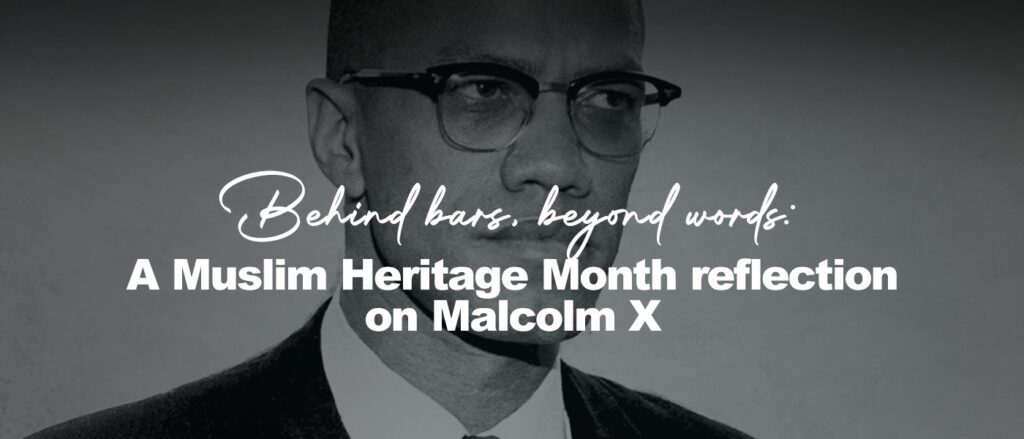
For many people, Malcolm X is remembered as a firebrand, a voice of rage, a man perpetually frozen in photographs mid-speech, finger pointed, eyes burning, and mouth open as if he were born in a state of fierce leadership and revolution. Although that’s not entirely false, this depiction is incomplete in a way that does both him, and us Muslims, a great disservice. To remember Malcolm X only as a political figure is to strip his life of its deepest meaning because the true axis of his transformation was not ideology, nor even racial consciousness, but Islam itself. What makes this nucleus of his life all the more empowering is that Malcolm X did not discover the religion of comfort, safety, and community in a mosque lit with bright lights or in a peaceful environment. This discovery began in a prison cell where a young man the world had already discarded began, for the first time, to reconstruct himself before Allah (SWT). Malcolm X’s story matters to the modern day American Muslims not only because he’s a famous personality, and not because he was gloriously eloquent, and also not because he was right about so much that this country still refuses to confront. It matters because his life is one of the clearest Muslim American examples of what The Quran describes when it speaks about hearts being turned, about people being brought from darkness into light, and about human beings rediscovering themselves when they finally encounter truth with sincerity. His journey forces us to grapple with a reality we often romanticize but rarely sit with, and that is, some of the most profound spiritual awakenings in this country have taken place behind bars, in spaces designed not for reflection but for erasure, where Islam arrives as the last rope lowered into a pit of darkness and solitude. When Malcolm X was sentenced to prison, he was a young Black man who had witnessed horrific levels of abandonment, violence, humiliation, and was met with the quiet and corrosive message that he was disposable. The streets had educated him in survival, but his journey had only just begun to discover his life’s true purpose. Prison, in the language of America, was supposed to be his end. The closing of his life’s chapter, and the warehousing of a problem yet in the merciful language of Allah (SWT), it became something else entirely. For Malcolm X, this became a threshold for a revolution that the world had yet to see. It became the place where a mind starved of direction began to feast on divine wisdom, history, and eventually, spirituality. It became the place where rage was slowly rechanneled into purpose, the place where a man who had learned to live against the world began to imagine living for something greater than himself. Allah (SWT) tells us in The Quran, “For each one there are successive angels before and behind, protecting them by Allah’s command. Indeed, Allah would never change a people’s state of favor until they change their own state of faith. And if it is Allah’s Will to torment a people, it can never be averted, nor can they find a protector other than Him.” (The Clear Quran®, 13:11) Malcolm X’s life is a living personification of this verse because what changed within him did not come from a reform program or an institution, but from an internal revolution that was sparked by the religion of Allah (SWT). He learned that discipline could be sacred. He learned that identity and his voice could be reclaimed, and through Islam, he learned that even someone buried under the weight of his past could stand before Allah (SWT) with a new name, a new direction, and a new claim to dignity. This is why, every incarcerated Muslim who opens a copy of The Quran in a cell, every man or woman who learns to pray under fluorescent lights, every person who encounters Allah (SWT) in a place built to strip them of selfhood is, in some way, walking a path Malcolm X illuminated. To speak about Malcolm X during Muslim American Heritage Month is not merely to honor a figure from the past, but to confront a living reality in the present. It is to ask whether we truly believe in the redemptive power we preach, whether we see prisons as graveyards for human potential or as fields in which Allah (SWT) still plants seeds, and whether we are willing to recognize that some of the most authentic expressions of Islam in America have emerged not from comfort, but from captivity. Malcolm X’s life demands that we remember Islam not as an accessory to success, but as a force that meets people at their lowest point and teaches them how to rise powerfully. The system that was unable to break Malcolm X To understand how Malcolm X became such a renowned personality, one must begin with the world that shaped the small boy known as Malcolm Little. This is significant because not only do we see the physical conditions that Malcolm X grew up in, but also the spiritual climate of a country that had mastered the art of robbing Black children of their futures. He was born in 1925 in Omaha, Nebraska into a world still vibrating with the aftershocks of slavery, even though it wore a mask of modernity. His father, Earl Little, was a Baptist preacher and because of his beliefs, he was a target. Malcolm X’s family was driven out of Nebraska, and although they traveled to Lansing, Michigan, racial oppression still followed them like an eerie shadow. In 1931, when Malcolm X was just six-years-old, his father was brutally murdered. Discrimination against Malcolm X’s family increased after the death of his father leading to the state intervening in his household and deeming his mother, Louis Little, unfit to parent her children. Malcolm X was separated from his siblings and placed into foster care. Despite these conditions, in the arena
The fear of being seen by Allah (SWT): Healthy taqwa or religious anxiety?
Among the most foundational truths that Islam instills in the consciousness of the believing soul is the awareness that Allah (SWT) is always present, fully observant of every external deed and internal intention, and absolutely knowledgeable of even the most fleeting thoughts that pass silently through our hearts. This profound reality, embedded throughout The Quran and Sunnah, is not intended to generate chronic psychological tension or fear-driven religiosity, but rather to anchor the believer in a state of mindful awareness, accountability, and spiritual refinement. However, in the lived experience of many modern Muslims, especially among those who strive sincerely to align their lives with divine guidance, this awareness can sometimes morph into a weighty emotional burden, where the constant thought of being watched by Allah (SWT) no longer serves as a source of strength or clarity, but becomes a cause of inner unrest or even compulsive religious behavior. This complexity demands a careful and spiritually informed inquiry: At what point does the fear of being seen by Allah (SWT) constitute a spiritually enriching and theologically sound manifestation of taqwa, and when might it transition into a form of unhealthy religious anxiety that burdens rather than uplifts the soul? To address this question thoroughly, we will delve into The Quranic vision of taqwa, explore how Prophet Muhammad (SAW) cultivated emotional balance in his spiritual life, reflect on classical scholarly insights regarding fear and hope, and finally consider psychological perspectives that can help contemporary Muslims navigate this emotionally charged aspect of their faith with both clarity and compassion. The linguistic and spiritual meaning of taqwa The Arabic term taqwa occupies a critical position in the vocabulary of The Quran and the Sunnah, and while it is commonly translated as “fear of Allah (SWT)” or “God-consciousness,” its linguistic and theological richness encompasses much more than mere apprehension or dread. Linguistically, taqwa is derived from the triliteral root و-ق-ي which conveys the meaning of protection, shielding, or safeguarding, particularly in the sense of guarding oneself from harm. In the religious and spiritual framework of Islam, taqwa refers to the act of protecting oneself from divine displeasure by remaining obedient to Allah’s (SWT) commands and steering away from His prohibitions, all while maintaining a state of constant, reverent awareness of His presence. This consciousness is not passive, but active and dynamic because it shapes how one thinks, behaves, speaks, and responds to the world. Imam ibn Rajab al-Hanbali, known for his profound insights into the inner dimensions of worship, defines taqwa as follows, “Taqwa is to act in obedience to Allah, upon a light from Allah, hoping for the reward of Allah, and to abandon disobedience to Allah, upon a light from Allah, fearing the punishment of Allah.” This eloquent articulation reveals that taqwa is not a feeling in isolation but a way of being that integrates divine knowledge, righteous action, sincere hope, and protective fear, all of which must be illuminated by revelation (nur min Allah). The Quran then commands, “O believers! Be mindful of Allah in the way He deserves, and do not die except in a state of full submission to Him.” (The Clear Quran®, 3:102) The Prophet (SAW) himself has powerfully reinforced this by consistently demonstrating that fearing Allah (SWT) is not a matter of emotional panic or spiritual paralysis, but rather a conscious, informed, and purposeful orientation of the heart. When the Messenger of Allah (SWT) was asked about righteousness, he replied, “Righteousness is good character, and sin is that which wavers in your heart and you dislike that people should come to know of it.” (Sahih Muslim) This hadith indicates that true God-consciousness operates through inner moral awareness, cultivated by faith and knowledge, rather than through external fear alone. Moreover, the Prophet (SAW) clarified the nature of authentic fear of Allah (SWT) when he said, “I am the most knowledgeable of you about Allah, and the most fearful of Him.” (Sahih Bukhari) Here, the Prophet (SAW) explicitly links fear of Allah (SWT) to knowledge and understanding, demonstrating that the most complete form of taqwa emerges not from anxiety or emotional excess, but from a deep recognition of Allah’s (SWT) greatness, mercy, and right to be obeyed. This Prophetic framework makes clear that fearing Allah (SWT) as He should be feared is an intentional, disciplined, and spiritually balanced state, one that shapes obedience, sincerity, and remembrance, rather than producing confusion, despair, or impulsive religiosity. When muraqabah inspires worship and when it becomes burdensome One of the highest stations of taqwa is muraqabah, a term that denotes a vigilant awareness that Allah (SWT) is watching, knowing, and recording every action, word, and intention. This is beautifully encapsulated in the famous hadith of Jibraeel (AS) where the Prophet (SAW) defined ihsan as, “That you worship Allah as though you see Him, and if you do not see Him, then indeed He sees you.” (Sahih Bukhari) This hadith is not meant to induce panic, but rather to instill deep sincerity and present-moment consciousness in the believer. The fear that stems from muraqabah is therefore of a noble type, and that is a catalyst for righteousness, not a source of despair or dysfunction. However, the line between muraqabah and religious anxiety can become blurred, especially when the fear of being seen by Allah (SWT) becomes exaggerated, obsessive, or detached from hope and understanding. When a believer constantly fears that every act may lead to divine punishment, despite sincere repentance and reform, this may no longer be healthy taqwa, but rather a manifestation of what modern psychology might term scrupulosity, a religiously framed anxiety disorder. How to balance between fear and hope Islamic theology never intended for fear to dominate the spiritual heart to the point of suffocation. The Quranic approach is one of balance between khawf and raja. In fact, Allah (SWT) describes the true believers as, “They abandon their beds, invoking their Lord with hope and fear, and donate from what We have provided for them.” (The Clear Quran®, 32:16) Fear alone can paralyze, while hope alone can delude. The scholars liken fear and hope to two wings of a bird. The believer cannot fly toward Allah (SWT) without both. Ibn al-Qayyim describes the ideal believer as one whose love for Allah (SWT) is the
Stories of the Anbiya: Who was the blueprint of mankind?
Stories of the Anbiya is a new series exploring the lives of the prophets mentioned in The Quran. Through these narratives, we aim to uncover not only the historical journeys of the prophets but also the timeless truths they reveal about the human soul, the struggle for justice, and the meaning of faith in a fractured world. This series is an invitation to revisit these lives with fresh eyes, and to see their stories echoed in our own. Within the religion of Islam, Prophet Adam (as) indeed occupies a uniquely and powerfully foundational position where he is not just the first human being, but also the first prophet, the first father, and the first khalifah of Allah (SWT) upon this earth. His story is the story of humanity itself. It begins in the heavens, moves through divine knowledge and angelic awe, encounters deception and regret, and then unfolds on earth through resilience, responsibility, and return. Prophet Adam (as) is truly the beginning of every soul, every civilization, and every spiritual journey, and so we must take it upon ourselves to study and reflect upon the glorious and powerful life that he has led which carry abundant lessons for us to learn from. Prophet Adam (as) has been mentioned 25 times in The Quran, often in different contexts, yet each time he has been mentioned, an important purpose to note has always followed. In Islamic theology, his creation was a deliberate act carried out by Allah (SWT). Within the Judeo-Christian framework, Prophet Adam (as) is usually cast as the “bearer of original sin”, but Islam has re-centered this narrative on mercy, learning, and accountability. Yes, Prophet Adam (as) made a mistake, but he also repented to the One who created him, and he was able to receive Allah’s (SWT) forgiveness and mercy. His error was certainly not “the be-all and end-all”, as many of us humans have come to accept. Rather, it showed the true nature of Allah’s (SWT) creations – that we are fallible, yet remain capable of attaining greatness. As Muslims, when we speak about Prophet Adam (as), we are outlining the divine blueprint for human life. His story sets the tone for the struggle between good and evil, obedience and rebellion, divine mercy and human fragility. Prophet Adam (as) is the first to experience loneliness, temptation, parenthood, loss, and repentance which are all core experiences of human life. In this deep dive, we will not only explore the well-known events of his life – such as his creation, his time spent in Allah’s (SWT) Paradise, the deception of Iblis, his descent to earth, and the tragedy of his sons – but also the deeper meanings of his stories that shape our understanding of who we are and why we’re even here. Prophet Adam’s (as) story isn’t limited to the story of the first man in creation, but it is the origin story to us all. The creation of Prophet Adam (as) Before the creation of man, a divine announcement was made. Allah (SWT) says in The Quran, “Remember when your Lord said to the angels, ‘I am going to place a successive human authority on earth.’ They asked Allah, ‘Will you place in it someone who will spread corruption there and shed blood while we glorify Your praises and proclaim Your holiness?’ Allah responded, ‘I know what you do not know.’” (The Clear Quran®, 2:30) This verse sets the tone for what human existence is meant to be. It was not a random act or any sort of experiment, it was a purposeful act of creation that was imbued with meaning and trust. The term khalifah signifies someone that has been entrusted with authority, stewardship, and responsibility. Humanity, then, was not born from any sort of chaos, but from discipline and intention. Prophet Adam (as) was created from clay which was dust mixed with water, shaped into the form of man, and then brought to life by the breath of Allah (SWT). The choice of natural material that Allah (SWT) selected to form the human body, is also deeply significant. Clay is humble, malleable, and grounded. It suggests that humans are both limited and adaptable, but the infusion of divine spirit elevated this earthen form into something sacred. This duality, earth and spirit, remains the core tension of the human experience. We are creatures of need and desire, yet capable of reflection and transcendence. What then follows is a moment that marks humanity’s exceptional status. Revealed in The Quran, “He taught Adam the names of all things, then He presented them to the angels and said, ‘Tell Me the names of these, if what you say is true?’” (The Clear Quran®, 2:31) This was an endowment by Allah (SWT) of knowledge, intellect, and capacity to categorize, abstract, and understand. Prophet Adam (as) was being honored not for his physical form, but for his mind and his soul, for his ability to learn, name, and know things. Knowledge, then, became the marker of superiority, and it is this divine gift that establishes humans as worthy stewards of the earth. Allah’s (SWT) command to prostrate and the rebellion of Iblis When Allah (SWT) presented Prophet Adam (as) to the angels and commanded them to prostrate, He (SWT) was not ordering this act so that the angels may worship him, but to give His khalifah the recognition and honor that he deserved. It was a bow to the divine wisdom of Allah (SWT) that had now manifested in creation. The angels, who are pure beings of light that never disobey and comply immediately, lowered their foreheads to the grounds of Jannah in sujood. However, one such angel among them deliberately refused. Iblis, who was made of smokeless fire instead of life, held a rank among the angels due to his devotion to Allah (SWT). Yet, when he was confronted with Prophet Adam’s (as) elevation, arrogance clouded his mind. In The Quran, it is written, “Allah asked, ‘What prevented you from prostrating when I commanded you?’ He replied, ‘I am better
From the Dajjal to the rising sun: Everything that will happen before and on the Day of Judgment
There is no concept in Islam that sobers the heart, humbles the intellect, and awakens the conscience quite like Yawm al-Qiyammah – the Day of Judgment. It is not a doctrine that we must memorize when we learn about the five pillars of Islam or a theological belief to be checked off as part of one’s faith. It is a reality that is so central to The Quran’s message and the Prophet’s (SAW) mission that it forms the spiritual backdrop against which all human life is meant to be understood. The Day of Judgment is the moment where all illusions fall away. It is the day when all souls are brought to account, when hidden truths are exposed, when every word, glance, intention, and deed is weighed with perfect justice. It is the day when even the most powerful rulers will stand barefoot and trembling, and the most unknown of believers may be crowned with honor. The Quran doesn’t just describe this Day with distant language; it immerses the reader in it, making it feel near, vivid, and urgent because it is. In a time when many are absorbed in the distractions of the dunya, when moral boundaries are blurred, and when injustice is both widespread and unpunished, the belief in the Day of Judgment is a moral and spiritual anchor. It reorients the soul, reminding the believer that his life is neither the beginning nor the end. It is but a station. The true home lies beyond. And that final return to Allah (SWT), the Most Just, is inevitable. This article will explore the concept of the Day of Judgment with the depth and seriousness it demands. From its signs, to the resurrection, to the standing before Allah (SWT), and the final reward or punishment, this is a journey that every soul will undertake. The only question is, how prepared are we? The inevitable arrival The Quran repeatedly affirms the certainty of the Day of Judgment. It does not leave room for metaphor or ambiguity. It is a Day that is coming, as sure as night follows day. In Surah Al-Mursalat, Allah (SWT) says, “Surely, what you are promised will come to pass.” (The Clear Quran®, 77:7)Lorem ipsum dolor sit amet, consectetur adipiscing elit. Ut elit tellus, luctus nec ullamcorper mattis, pulvinar dapibus leo. The word used, la waaqi, is strong in its tone connoting that this is not merely probable, but inevitable. In many verses, The Quran couples belief in Allah (SWT) with belief in the Last Day, indicating that faith is incomplete without it. For a person to truly grasp the nature of divine justice, the tests of this life, and the purpose of suffering and patience, belief in the Hereafter is essential. Our beloved Prophet (SAW) constantly reminded his companions of the Hereafter, and often in ways that left a lasting imprint on their hearts. In one powerful narration, he (SAW) said, “How can I enjoy this life when the one with the horn (i.e., Angel Israfil) has placed the horn to his lips, tilted his forehead, and is listening attentively, waiting for permission to blow?” (Musnad Ahmad) This vivid imagery portrays the sheer imminence of the Day of Judgment as not some distant, far-off event, but as something waiting only for Allah’s (SWT) command. The Sahabah, upon hearing this, were shaken. They understood that every moment in this world was a step toward a final, eternal reality. Their belief in the Hereafter was not abstract, it shaped their worship, humbled their ambitions, and inspired their patience in hardship. They lived each day knowing that at any moment, the trumpet could sound, and the world as we know it would end. The companions knew that they would stand before the One who sees all, hears all, and forgets nothing. The signs before the storm Out of His immense mercy, Allah (SWT) has not left His creation in total suspense. Through the Prophet (SAW), He (SWT) has described both minor and major signs that precede the Final Hour. These signs are not put into place so that we may spend our time marveling at them or engaging in apocalyptic speculation; they are meant to awaken the heart, shake the heedless, and motivate sincere change within ourselves and societies. The minor signs, many of which we see today, include: Obsession of wealth and lack of charity. The arrival of the Prophet (SAW). Conquest of Jerusalem. Constructions of grand masajid and towering buildings (& competitiveness within societies to build them). Deliberate ignorance, and people will abstain from practicing the deen. Immorality and shamelessness will become normalized. Widespread use of riba. Bloodshed and unjust killings. Disobedience to the elderly, especially the parents. Women will dress immodestly. The rise and surge in false prophets. Increase in natural disasters such as earthquakes, tsunamis, etc. Sudden death will be common. The major signs, on the other hand, are way more terrifying and earth-shattering. They include: The rise of Dajjal. Prophet Isa (AS) will descend upon the earth. The appearance of Ya’juj and Ma’juj. Three major landslides. Dabbat al-Ard. The sun will rise from the West. Atmospheric phenomenon of smoke covering the people. A fire from Yemen that will drive people to their final gathering. The arrival of the Mahdi, the descendant of the Prophet (SAW). The Prophet (SAW) has said, “When three things appear, no soul will benefit from its faith if it had not believed before: the rising of the sun from the west, the Dajjal, and the Beast of the Earth.” (Sahih Muslim) The resurrection and the gathering After the trumpet is blown by Angel Israfil, not once, but twice, the world will be undone. The first blast will bring death to every living creature. Mountains will crumble like cotton, seas will boil, the sky will tear apart, and then, after a period only known to Allah (SWT), the second trumpet will be blown, and every soul, from the first human to the last, will rise from their graves. This is not symbolic, it is very much real. The Quran says, “Beware of the Day the earth will split open, letting them rush forth. That will be an easy gathering for