If my life is already written, then what’s the point?
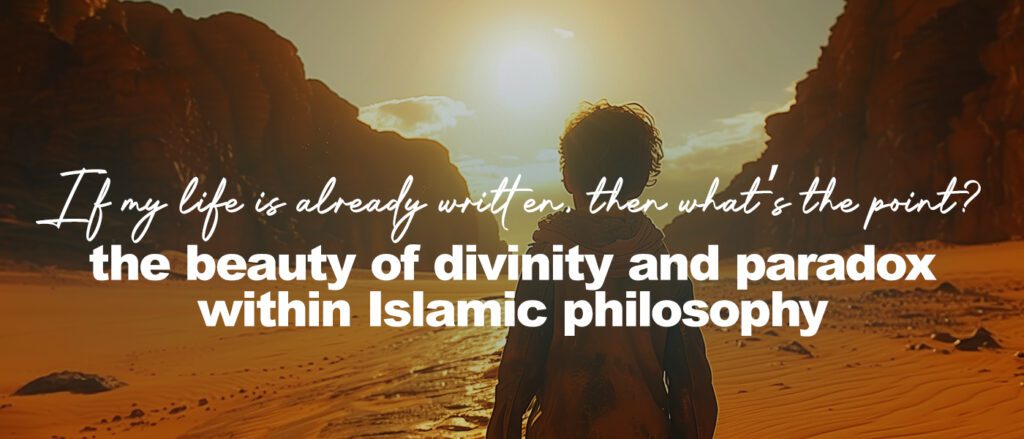
The beauty of divinity and paradox within Islamic philosophy The paradox between free will and divine knowledge is one of the most challenging and enduring questions in Islamic theology, also known as ‘ilm al-kalaam, engaging scholars from the earliest generations of Islam to the modern day. How can human beings possess moral responsibility if all is foreknown by an all-knowing God? This article will explore the tension between divine omniscience, ‘ilm Allah, and human volition, ikhtiyaar, examining Quranic foundations, hadith literature, classical theological responses, and the spiritual implications of living within this paradox. In doing so, it aims to clarify misconceptions and offer an intellectually honest yet spiritually nourishing perspective rooted in the Islamic worldview. For every thinking Muslim, young or old, scholar or layperson, there comes a time when a deeply unsettling question emerges. If Allah (SWT) already knows what I’m going to do, then do I really have a choice? And if everything has already been decreed, then what role do my efforts, intentions, and moral accountability truly play? These questions are neither new, nor are they abnormal to ask or be curious about. They echo from the earliest generations of Islam. In fact, when a man asked the Prophet (SAW) about qadr, his companions became so enraged at the question that the Prophet (SAW) had to calm them down. Yet, the Prophet (SAW) did not dismiss the question, he engaged it. Why? Because Islam never silences sincere inquiry, it disciplines it. The objective of this article is not to offer simplistic answers, but to faithfully unpack the Islamic tradition’s depth in addressing this profound tension. Divine knowledge is timeless and total, but never tyrannical In Islam, Allah’s (SWT) knowledge is not like ours. We know things after they happen. We learn through experience. Allah’s (SWT) knowledge, by contrast, is eternal which means it is without beginning or end. He (SWT) does not wait to see what we will do. He (SWT) already knows. Allah (SWT) says, “Surely Allah knows the unseen of the heavens and earth. And Allah is All-Seeing of what you do.” (The Clear Quran®, 49:18) Let’s look at this simple analogy to make this concept more clear for us all. A mother knows her child incredibly well and will easily gauge what the child will do, how they will behave, and how they will react to certain circumstances, but that doesn’t mean that she caused the result. The child will make efforts, or fail to, and the results will reflect their actions. Her foreknowledge doesn’t deny their agency. It reflects her insight. Now, imagine that analogy stretched to its absolute perfection. Allah’s (SWT) knowledge is not predictive, it is absolute. He (SWT) knows what we will choose, how we will choose it, and what was in our hearts when we made those decisions, but we are still the ones making them. Free will for humans is a real concept with limitations The Quran speaks often about human responsibility. It repeatedly calls us to make choices, to reflect, to act righteously, and to take account of ourselves. Allah (SWT) says, “We already showed them the Way, whether they choose to be grateful or ungrateful.” (The Clear Quran®, 76:3) Further, He says, “Whoever does good, it is to their own benefit. And whoever does evil, it is to their own loss. Your Lord is never unjust to His creation.” (The Clear Quran®, 41:46) These verses are not just poetic encouragement. They are theological declarations. The Quran is holding us responsible for our choices, because we do, in fact, choose. But here’s what’s crucial: Islam never claimed that we have absolute freedom. We do not choose when we are born. We do not choose what family we are born into, or what trials we face. We do not control the outcomes of our actions. We are, in fact, limited beings within a broader Divine reality. Our will is real, but it operates within the will of Allah (SWT). “But you cannot will to do so unless Allah wills. Indeed, Allah is All-Knowing, All-Wise.” (The Clear Quran®, 76:30) verse is not a negation of our will, it’s a framing of it. We choose, we intend, we act, but all of it unfolds in a universe created, sustained, and known by Allah (SWT). Our freedom is delegated, not absolute. We are free within the limits that Allah (SWT) has set, just as a child is free to walk around a playground, though they remain within the boundaries set by their guardian. A common response to misunderstandings about qadar One of the most damaging misunderstandings among Muslims today is the idea that “everything is already written, so why should I try?” This is not Islamic theology, it’s qadar-based fatalism, and it’s a deviation from the path of the Prophet (SAW). Let us reflect on the well-known hadith, “A man asked: ‘O Messenger of Allah, should we not rely on what has been written (i.e., our fate)?’ The Prophet (SAW) replied, ‘No, act, for everyone will find easy that for which they were created.’” (Sahih Bukhari) The Prophet (SAW) rejected passive fatalism. He taught that qadar is not an excuse to surrender effort, but a reason to work with humility. It’s important to note that this hadith was given after the Prophet (SAW) explained that Allah (SWT) had written the decree of every person in the womb, including their sustenance, actions, and whether they would end up in Jannah and Jahannam. Yet even in light of this complete knowledge, the Prophet (SAW) insisted, “Act!” This is the beauty of Islamic theology because it allows for divine foreknowledge and human responsibility to coexist, because it doesn’t treat them as competing truths. The role of dua and effort Another misconception is that if everything is already written, then dua is pointless. However, the Prophet (SAW) has taught us the opposite. He says, “Nothing repels the Divine Decree except dua.” (Tirmidhi) This statement is radical. It means that some aspects of qadar are conditional, they can change through prayer, action, and sincere repentance. This is known in theology as qadar mu’allaq, the contingent decree, as opposed to qadar mubram, the absolute, unchanging decree in Allah’s
The Man the Angels Were Shy Around: Reflecting on the Character of Uthman ibn Affan (RA)
Uthman ibn Affan (RA) may not have been the most outspoken or commanding figure among the companions, but his quiet strength, deep faith, and generosity left a lasting imprint on the history of Islam. He was a man who led not through force, but through character, and he was known for his modesty, his love for The Quran, and his willingness to give everything he had for the sake of Allah (SWT). His life offers something relatable to all of us whether young or old, and that is a reminder that true leadership begins with sincerity and ends with sacrifice. Early life and his acceptance of Islam Uthman ibn Affan (RA) was born into the noble Umayyad clan of the Quraysh, one of the wealthiest and most respected families in Makkah. His upbringing was marked by refinement, literacy, and commerce. Even before accepting Islam, Uthman ibn Affan (RA) was known for his honesty, his generosity, and his pure character. He was among the rare Arabs of the time who could read and write, a skill that would later play a pivotal role in the preservation of The Quran. When the Prophet Muhammad (SAW) began to call people to Islam, Uthman ibn Affan (RA) did not hesitate. He embraced the message early, becoming one of the first ten to accept Islam through the efforts of his close friend Abu Bakr as-Siddiq (RA). Despite being wealthy and influential, Uthman ibn Affan (RA) chose to leave behind the ease of his privileged life for the truth of Islam. He faced the backlash of his tribe and family with quiet resolve. He was also among the few companions who participated in both migrations — first to Abyssinia with his wife Lady Ruqayyah bint Muhammad (RA), and later to Madinah. This dual migration is a mark of his early and enduring commitment to the faith. Marriage to the daughters of the Prophet (SAW) One of the unique honors of Uthman ibn Affan (RA) was his marriage to Lady Ruqayyah bint Muhammad (RA), the daughter of the Prophet (SAW). When she passed away, the Prophet (SAW) offered him his other daughter, Lady Umm Kulthum bint Muhammad (RA), in marriage. For this reason, Uthman ibn Affan (RA) is known as “Dhu al-Nurayn” — the Possessor of Two Lights. No other man in history has been married to two daughters of a prophet, which itself speaks to his closeness and trustworthiness in the eyes of Rasulullah (SAW). Modesty and generosity Uthman ibn Affan (RA) was a man of great haya (modesty), a trait so profound that even the angels respected it. The Prophet (SAW) once said, “Should I not feel shy of a man before whom the angels feel shy?” (Sahih Muslim) He was also among the most generous companions. During the Tabuk expedition, when the Muslims were in dire need of resources, Uthman ibn Affan (RA) provided 300 camels, along with gold and silver. The Prophet (SAW) responded by saying, “Nothing Uthman does after today can harm him.” (Jami‘ al-Tirmidhi) This wasn’t a one-time act. Uthman ibn Affan (RA) also bought and donated the famous well Bi’r Rumah in Madinah so that Muslims could have free access to clean water. Participation in early battles Although Uthman ibn Affan (RA) missed the Battle of Badr due to caring for his ill wife Lady Ruqayyah bint Muhammad (RA), the Prophet (SAW) assured him: “You [Uthman] will receive the same reward and share (of the booty) as anyone of those who participated in the battle of Badr.” (Sahih al-Bukhari) He later participated in other key battles such as Uhud and the Battle of the Trench. During the campaigns of Ghatafan and Dhat al-Riqa, the Prophet (SAW) entrusted Uthman ibn Affan (RA) with the leadership of Madinah in his absence — a sign of deep trust. The caliphate of Uthman ibn Affan (RA) After the passing of Umar ibn al-Khattab (RA), Uthman ibn Affan (RA) was chosen as the third caliph of Islam. His caliphate lasted 12 years — the longest among the Rightly Guided Caliphs. The first six years were marked by growth, peace, and expansion. Islam spread into North Africa, Persia, and deeper into the Byzantine territories. Expansion of the Islamic Empire Under Uthman ibn Affan’s (RA) leadership, the Muslim world saw unprecedented territorial growth: North Africa: Muslim forces advanced into Tripoli and Tunisia (Ifriqiya), laying the groundwork for future expansion into the Maghreb. Persia and Central Asia: The final remnants of the Sasanian Empire were subdued, including regions like Khorasan and Transoxiana. Naval Power: Uthman ibn Affan (RA) authorized the creation of the first Muslim navy, leading to the historic Battle of the Masts (655 CE), a major victory against the Byzantines off the coast of Lycia. Administrative Reforms Uthman ibn Affan (RA) introduced several key reforms to manage the rapidly expanding Islamic empire. His leadership was marked by foresight and a sincere desire to unify the Ummah and ensure stability across newly conquered lands. Governorships: Uthman ibn Affan (RA) appointed trusted individuals to govern key provinces such as Syria, Egypt, Kufa, and Basra. Land Grants and Economic Policy: As the empire grew, Uthman ibn Affan (RA) implemented a system of land distribution to reward military service and stabilize frontier regions. He also oversaw the management of public funds and ensured that the spoils of conquest were used to benefit the Muslim community. His policies helped maintain economic growth and infrastructure across the caliphate. Centralization of Governance: Uthman ibn Affan (RA) sought to streamline administration by centralizing decision-making and standardizing procedures across provinces — necessary for managing a vast and diverse empire. Standardization of The Quran Perhaps the most significant contribution of Uthman ibn Affan (RA) during his leadership was the standardization of The Quran. As Islam spread to non-Arab regions, different dialects of Quranic recitation caused confusion. Recognizing the danger, Uthman ibn Affan (RA) formed a committee, led by Zayd ibn Thabit (RA), to compile The Quran into a single, standardized mushaf based on the Qurayshi dialect. He then sent copies to different provinces to protect the Ummah from future disagreement. For this preservation, Uthman ibn Affan (RA) is remembered
Islamic Philosophy was way ahead of its time, and here’s why
From the earliest centuries of Islamic history, Muslims have asked deep questions about the universe, existence, the human soul, ethics, and the nature of God. These are philosophical questions that demand careful thinking and deep reflection. But how does Islam, a religion based on divine revelation, interact with philosophy, a field based on human reasoning? This article aims to explore the relationship between Islam and philosophy in a way that is clear, balanced, and faithful to the teachings of The Quran and Sunnah. We will discuss the historical interaction between Islam and philosophy, what Islamic texts say about thinking and reasoning, and how Muslim scholars have approached philosophy in various ways. Finally, we will consider how Muslims today can benefit from philosophy without compromising their faith. The place of reason in Islam One of the most beautiful aspects of Islam is how it encourages the use of reason and reflection. In The Quran, Allah (SWT) does not ask us to blindly follow, but rather to think, to reflect and to understand. Allah (SWT) says, “Indeed, in the creation of the heavens and the earth and the alternation of the day and night there are signs for people of reason.” (The Clear Quran®, 3:190) This verse is an invitation to contemplate the universe and seek meaning. Allah (SWT) describes the believers as those who reflect on creation and say, “They are those who remember Allah while standing, sitting, and lying on their sides, and reflect on the creation of the heavens and the earth and pray, ‘Our Lord! You have not created all of this without purpose. Glory be to You! Protect us from the torment of the Fire.’” (The Clear Quran®, 3:191) In more than 750 verses, The Quran invites the reader to think (yatafakkarun), understand (ya’qilun), and reflect (yatadabbarun). This shows that Islam does not reject reason. Instead, it places reason in its proper position which is to use it as a tool to understand the signs of Allah (SWT), not as a replacement for revelation. Our beloved Prophet (SAW) has also encouraged reflection. He said, “Indeed, in the body is a piece of flesh; if it is sound, the whole body is sound. If it is corrupt, the whole body is corrupt. Indeed, it is the heart.” (Sahih Bukhari) The heart (qalb) in the Islamic worldview is not just an organ where you feel emotion intensely, it is also the center of understanding. The Quran says, “Indeed, We have destined many jinn and humans for Hell. They have hearts they do not understand with, eyes they do not see with, and ears they do not hear with. They are like cattle. In fact, they are even less guided! Such people are entirely heedless.” (The Clear Quran®, 7:179) This shows that intellect and spirituality go hand-in-hand in Islam. Thinking deeply is not a danger to faith, rather, it can be a way to strengthen it. The historical interaction between Islam and Philosophy Islamic civilization has a long and rich history of engaging with philosophy. When Muslims spread into Persia, India, and the Roman world, they encountered Greek philosophical texts, mainly those of Plato, Aristotle, and others. During the Abbasid Caliphate, especially the 8th to 10th centuries, many of these works were translated into Arabic. This period became known as the Islamic Golden Age. Muslim scholars like Al-Kindi (known widely as The Philosopher of the Arabs), Ibn Sina (known in the West as Avicenna), Al-Farabi (known in the West as Alpharabius), and Ibn Rushd (known in the West as Averroes) studied Greek philosophy and tried to harmonize it with Islamic teachings. They explored questions such as: What is the nature of the soul? Can reason prove the existence of God? How should a just society be governed? What is the meaning of happiness? These thinkers were not copying Greek philosophy; they were taking it much further – critically engaging with it and trying to place it in an Islamic framework. However, not all scholars agreed with their approach. The great scholar Imam Al-Ghazali wrote a famous book titled Tahafut al-Falasifah (The Incoherence of the Philosophes), in which he criticized certain philosophical claims, especially those that contradicted The Quran, such as the denial of bodily resurrection or the idea that the world had no beginning. Ghazali did not reject all philosophy, but he warned Muslims against ideas that went against core beliefs. He even wrote books on logic and ethics that used philosophical methods, but always with The Quran and Sunnah as the foundation. Later on, Ibn Rushd responded to Ghazali’s critique with his own book, Tahafut al-Tahafut (The Incoherence of the Incoherence), defending philosophy as a valid tool to understand faith. This historical debate shows us something important: Islam allows for intellectual diversity as long as the boundaries of revelation are respected. The Quran, hadith, and philosophical thinking While The Quran is not a book of philosophy, it addresses many of the same questions that philosophy does. Existence of God: Allah (SWT) says, “Or were they created by nothing, or are they their own creators?” (The Clear Quran®, 52:35). This verse challenges atheistic thinking in a logical and rational manner. Free will and destiny: Allah (SWT) says, “We already showed them the Way, whether they choose to be grateful or ungrateful.” (The Clear Quran®, 76:3) This verse shows the Islamic balance between divine decree and human choice which is a topic philosophers have debated for centuries. Ethics and morality: Allah (SWT) says, “Indeed, Allah commands justice, grace, as well as generosity to close relatives. He forbids indecency, wickedness, and aggression. He instructs you so perhaps you will be mindful.” (The Clear Quran®, 16:90) This verse lays the foundation for an ethical society, beyond philosophical speculation. The Prophet (SAW) also spoke about questions of existence and creation. One hadith says, “People will keep asking questions until they say, ‘This is Allah Who created everything, then who created Allah?’ Whoever has thoughts like this, let him say: I believe in Allah.’” (Sahih Muslim) This shows that while Islam welcomes questions, it also warns against infinite regress in reasoning, something philosophers have struggled with. Islam teaches
What are the seven layers of Hell in Islam, and who will enter them?

Hell is not a concept to be brushed aside or spoken of lightly. In Islam, the reality of Jahannam, or Hellfire, is one of the core elements of our belief in the unseen – the ghayb. It is part of our belief in the Last Day, one of the six pillars of faith – also known as arkan al-iman, and it is an essential concept repeated frequently in The Quran. Understanding Hell is not about spreading fear for the sake of fear, it is about developing God-consciousness, instilling moral responsibility, and awakening the heart to the consequences of sin, disbelief, and hypocrisy. Allah (SWT), in His infinite Wisdom, has revealed descriptions of both Jannah and Jahannam so that human beings may reflect, choose the path of righteousness, and realize that this life is not the end. In a time where many are distracted by the material world and desensitized to sin, the subject of Hell is especially relevant. Young Muslims around the world often struggle with weak connection to the akhirah, and communities can fall into spiritual stagnation when reminders of accountability are absent. For this reason, scholars from the earliest generations always emphasized not only the mercy of Allah (SWT), but also His justice. The Quran itself balances the two, with verses about Paradise often followed by verses about Hell to create a complete picture that leads to hope and fear, raja’ wa khawf, in Allah (SWT). This article will aim to explore the concept of the seven layers of Hell in Islam, as described in The Quran and hadith. Each layer represents a deeper level of punishment, designated according to the severity of disbelief, hypocrisy, and sin. Drawing from classical sources of tafsir, hadith, literature, and spiritual reflections, this piece seeks to educate and awaken the Muslim reader with sincerity and clarity. The reality of Hell in The Quran and Sunnah Before examining the layers, we must affirm a crucial Islamic truth, and that is that Jahannam is real. It is not Is it symbolic of anything nor is it some mere psychological concept. It is a created place that exists, and will remain as an eternal abode of punishment for those whom Allah (SWT) has destined for it. It is one of the first creations of Allah (SWT) concerning the Hereafter. In a lengthy and descriptive hadith, the Prophet (SAW) has said, “When Allah created Paradise and Hell, He sent Jibraeel (AS) to Paradise, saying, ‘Look at it and what I have prepared in it for its inhabitants.’ So he went and looked at it, then came back and said, ‘By Your Glory, no one hears of it but will enter it.’ So He surrounded it with hardships and said, ‘Go back and look at it and what I have prepared in it.’ So he went and looked at it, then said, ‘By Your Glory, I fear that no one will enter it.’ Then He said, ‘Go to Hell and look at it and what I have prepared in it.’ So he found it in layers, one above the other. Then He surrounded it with desires and said, ‘Go back and look at it.’ So he said, ‘By Your Glory, I fear that no one will be saved from it.’” (Tirmidhi) This powerful hadith illustrates the reality, danger, and layers of Hell. The Quran refers to Hell more than 130 times, using different names that describe its qualities and severity such as Jahannam, Sa’ir, Saqar, Laza, Jaheem, Hutamah, and Hawiyah – all of which we will explore below. Layer #1: Jahannam as the temporary residence for sinful believers The word Jahannam itself is used in The Quran as a general term for Hell. However, some scholars say it also refers to the uppermost and least severe level. This is where some disobedient Muslims, those who believed but committed major sins without repentance, may be sent. So, who will enter this level? Muslims who were neglectful in fulfilling their religious obligations such as the following: Those who prayed occasionally or delayed salah without valid reasons. Those who engaged in riba (interest), fornication, drinking alcohol, or other major sins while ignoring opportunities to seek forgiveness. Muslims who were arrogant, abusive, or unjust, yet claimed to follow Islam. However, this punishment, according to authentic ahadith, is not eternal. Anyone who dies with even a small seed of faith will eventually leave Hell and enter Jannah. The Prophet (SAW) said, “Whoever says, ‘La ilaaha ilallah’ and has in his heart goodness equal to a barley grain will be taken out of the Fire.” (Sahih Muslim) However, the suffering experienced in Jahannam, even temporarily, is beyond our imagination. It is still a fire fueled by people and stones (The Clear Quran®, 2:24), and not something a believer should take lightly. The lesson here is don’t rely solely on “being Muslim”; our actions matter, and sincere repentance is essential. Layer #2: Laza is the place for those who rejected Tawheed after knowing the truth Laza is described in The Quran as a blazing fire that strips away the outer layers of a person. In The Quran, Allah (SWT) says, “But no! There will certainly be a raging Flame ripping off scalps. It will summon whoever turned their backs on Allah and turned away from the truth, and gathered and hoarded wealth.” (The Clear Quran®, 70:15-18) Who will enter this level? This level is for those who: Knowingly rejected the message of Islam, especially after recognizing its truth. Turned their backs on Tawheed (belief in the Oneness of Allah (SWT)). Committed shirk (associating partners with Allah (SWT)) in worship. These are people who may have been exposed to Islam, through reading, witnessing, or personal experience, but still chose arrogance over submission. This level includes atheists, polytheists, and those who chose to live in active rejection of divine truth. The key lesson here is that rejection of Tawheed doesn’t entirely come from ignorance, it can come from arrogance, self-importance, or love for the worldly life. Laza awaits those who knew and still made the conscious choice to turn away. Layer #3: Saqar is the place for those who abandoned prayer and neglected the poor The level of Saqar is introduced in one of the most terrifying dialogues in The Quran. Allah (SWT) says, “‘What has landed you in Hell?’ They will reply, ‘We were not of those who prayed, nor did we feed
The Ummah and AI: Who owns the future of knowledge?

The 21st century is witnessing a profound shift in how human beings interact with knowledge. What was once stored in books, passed through teachers, and contemplated in solitude is now increasingly mediated by machines. Artificial intelligence (AI) systems are becoming gatekeepers of information, creators of content, and decision-makers in fields as diverse as education, medicine, law, and even religion. For the Muslim Ummah, a global community built on the sacred centrality of ilm, this development presents a deeply urgent question: who owns the future of knowledge? And, more importantly, what role should Muslims play in shaping that future? This question is not only technical or economic, it is spiritual, ethical, and civilizational. At its heart lies a tension between automation and intention, data and wisdom, and machines that process and humans who reflect. As a faith that began with the divine command iqra, Islam compels its followers not to merely seek knowledge but to preserve its sanctity, embody its ethics, and ensure its benefit for all creation. This article aims to offer a critical Islamic reflection on the rise of artificial intelligence and what it means for the future of knowledge. It draws on The Quran, Sunnah, classical Islamic scholarship, and contemporary academic thought to provide a framework for understanding both the risks and the responsibilities we face. This is not a call to fear technology, but to engage with it consciously, ethically, and spiritually. Islamic epistemology declares knowledge as a sacred trust In Islamic tradition, knowledge is not a commodity. It is a divine trust, a light given by Allah (SWT) to guide human beings. The Quran repeatedly emphasizes the value of knowledge, distinguishing those who possess it from those who do not. Allah (SWT) says in The Quran, “Are they better or those who worship their Lord devoutly in the hours of the night, prostrating and standing, fearing the Hereafter and hoping for the mercy of their Lord? Say, O Prophet, ‘Are those who know equal to those who do not know?’ None will be mindful of this except people of reason.” (The Clear Quran®, 39:9) The story of Prophet Adam (AS), the first human being, illustrates this foundational principle. When Allah (SWT) created Him, He (SWT) taught him the names of all things; this is a symbolic gesture marking the human capacity for abstract thought, categorization, and understanding. The Quran says, “He taught Adam the names of all things, then He presented them to the angels and said, ‘Tell Me the names of these, if what you say is true?’” (The Clear Quran®, 2:31) This divine act of teaching was not a passive transmission of labels, but a sacred initiation into the moral responsibility that comes with knowing. In contrast to the angels, who submitted without knowledge of creation’s details, Prophet Adam’s (AS) unique status as a knower earned him the role of caretaker of the earth. Scholars like Imam al-Ghazali and Ibn Taymiyyah further developed Islamic epistemology, emphasizing that sound knowledge is that which leads to beneficial action and nearness to Allah (SWT). Imam al-Ghazali, in his magnum opus Ihya ‘Ulum al-Din, famously warned that knowledge divorced from action becomes a form of hypocrisy, while action without knowledge is misguidance. For knowledge to be valid in the Islamic framework, it must be guided by sincerity and ethical purpose. This holistic conception of knowledge contrasts sharply with the mechanistic and utilitarian model that underpins much of modern AI. Artificial intelligence is the new engine of knowledge Artificial intelligence, in simple terms, refers to the ability of machines to mimic human cognitive functions, learning, reasoning, problem-solving, and decision-making. Through complex algorithms, AI systems are trained on massive datasets, allowing them to recognize patterns, make predictions, and generate content. From AI-powered language models and automated legal assistants to facial recognition and surveillance systems, these technologies are reshaping the way knowledge is created, accessed, and applied. On the one hand, AI offers tremendous potential. It can help us translate languages, diagnose diseases, detect fraud, optimize systems, and even answer religious queries. On the other hand, though, AI does not understand the knowledge it processes. It does not possess consciousness, morality, or accountability. It has no soul, no intention, and no sense of ultimate purpose. As Muslims, this presents a profound theological question: can tools devoid of taqwa be trusted to mediate knowledge? And if knowledge is a trust from Allah (SWT), are we fulfilling our responsibility by allowing machines to act as arbiters of truth without human ethical oversight? Risks of AI: Epistemic and ethical concerns While AI promises to revolutionize human life, it also introduces serious risks, many of which go unrecognized or are dismissed as mere technicalities. From an Islamic perspective, these risks must be understood not only in terms of functionality but in light of justice, accountability, and the protection of human dignity. One of the primary concerns is epistemic bias. Most AI systems are built using data collected in secular, Western contexts. This creates an inherent skew in how information is classified, ranked, and retrieved. For example, online search engines and content filters may deprioritize Islamic perspectives or misrepresent them entirely. This is a form of epistemic injustice, where certain worldviews are systematically excluded or marginalized. Moreover, the lack of ethical intent in AI creates a dangerous form of moral outsourcing. When people turn to AI to make judgments, whether in hiring, policing, education, or even issuing fatwa, we risk delegating moral responsibility to systems that cannot bear it. The Prophet (SAW) said, “Each of you is a shepherd, and each of you is responsible for his flock.” (Sahih Bukhari) Responsibility is a moral burden that cannot be shifted to machines. Human beings, not algorithms, will be held accountable on the Day of Judgment for the decisions we make, or allow to be made in our name. Lastly, there is a danger of spiritual complacency. The automation of knowledge, particularly in religious spaces, can reduce Islam to a set of searchable facts or machine-generated rulings. But Islam is not only about
The Quran and Sunnah are the Islamic blueprints for peaceful resistance
In the dusty valley of Ta’if, the Messenger of Allah (SAW) stood with bleeding feet and a heavy heart. He (SAW) had come with a message, and his intention was not to conquer the lands, but to invite people towards a path of righteousness. He (SAW) spoke calmly to the leaders of the town, hoping that they might listen. However, instead of giving such a merciful, humble, patient, and kind man any sort of a welcome, he (SAW) was met with insults, laughter, and eventually, pelted with stones from head to toe. The children were unleashed on him, chasing him out, and the adults merely stood by and watched as the Mercy to Mankind (SAW) was dripping in his own blood, and mocked out of the city. This was a moment of sheer and total rejection by the ignorant. This is a moment where, for most people, retaliation from the Prophet (SAW) would have indeed been justified and maybe even necessary; however, the Prophet (SAW) raised his hands not to strike back, but to make a heartfelt dua. Afterwards, when the Archangel Jibraeel (AS) came offering to crush the people of Ta’if between the mountains, the Prophet (SAW) replied, “No. I hope that Allah brings from their descendants those who will worship Him alone without associating any partners with Him.” (Sahih Bukhari) This story isn’t one that we should just read in our sirah books and then move on from to the next page. This requires a great deal of reflection from us as Muslims because this is a window into the moral weight of Islam. In that moment, the Prophet (SAW) demonstrated something that very few people understand today: non-violence is not a sign of weakness, surrender, or defeat; it is an act of high faith. In a world increasingly defined by anger, vengeance, and reaction, Muslims are often caught between two extremes—those who encourage passive silence and those who believe that dignity can only be reclaimed through aggression. The truth, however, lies in The Quran and in the Sunnah of the Prophet (SAW). Islam is a religion of justice without cruelty, strength without oppression, and mercy without compromise. Regardless of what the media may try to feed the people in the West, our history is a huge testament to the fact that Islam always was, and will always be, a nonviolent religion. This article will explore how non-violence is understood within Islam not as an imported political theory, but as a deeply rooted prophetic principle. We will examine how The Quran defines restraint, how the Prophet (SAW) practiced it, and how the Muslim community can apply it today, especially in moments of tension, hardship, or injustice. The Quran’s teachings on how to respond to misconduct and harm in a way that pleases Allah (SWT) The Quran has never called upon or encouraged the Muslims to surrender their dignity, but it has taught them to rise above impulsive retaliation. In The Quran, Allah (SWT) says, “The true servants of the Most Compassionate are those who walk on the earth humbly, and when the foolish address them improperly, they only respond with peace.” (The Clear Quran®, 25:63) Here, the believers are described not as timid or passive, but as dignified and deliberate. Their power lies in choosing peace over provocation. Their response is calm, not because they cannot fight, but because they are conscious of Allah (SWT). Another powerful verse on non-violence is, “Good and evil cannot be equal. Respond to evil with what is best, then the one you are in a feud with will be like a close friend.” (The Clear Quran®, 41:34) The scholars of tafsir mention that this verse is not simply about being polite. It refers to moral resistance, to choosing the higher path when dealing with hostility. It requires deep self-control and sincerity, especially when your emotions are high. However, this does not mean that Islam ignores oppression. In fact, the same Quran that praises patience also permits defensive resistance when necessary. Allah (SWT) says, “Permission to fight back is hereby granted to those being fought, for they have been wronged. And Allah is truly Most Capable of helping them prevail.” (The Clear Quran®, 22:39) The balance here is critical, and that is, non-violence is the default, but when justice demands action, Islam allows it, under strict ethical guidelines. Rasulallah (SAW) has taught us how to live a life of restraint and moral discipline If anyone had the right to retaliate with force, it was the Prophet (SAW). Yet, the overwhelming pattern of his life was one of restraint, even when insulted, threatened, or attacked. The clearest examples come from the Makkan period, where the Muslims were mocked, tortured, and economically boycotted. Yet, the Prophet (SAW) never organized retaliation during that time. Not because he (SAW) lacked courage or support, but because he (SAW) was training his followers in sabr, mercy, and long-term thinking. Even after the conquest of Makkah, when the Quraysh expected vengeance, he (SAW) declared, “Go, for you are free.” (Ibn Hisham) He (SAW) had power in that moment, but he (SAW) used it for reconciliation, not revenge. He (SAW) modeled leadership based on mercy and humility. However, there were also moments when force was used such as in the battles of Badr, Uhud, and others. However, even then, the Prophet (SAW) imposed strict rules: Do not kill women, children, or the elderly. Do not harm crops or animals. Do not mutilate bodies. Do not pursue those who flee. These rules are not the norms of ancient warfare; they are the ethics of a Prophet who understood that even in conflict, Muslims must remain spiritually and morally accountable. How can we all live a life of peace and moral discipline in a world of injustice? Many Muslims today are unsure of how to apply these teachings because it can be quite difficult with what we see happening around the world. In a time of injustice from Islamophobia to tensions overseas, is non-violence still a valid path? The answer is, yes, but not in the way the modern world defines it. Islamic non-violence is not
Why a civilization can never flourish without the elderly
In many homes, we often find that there is a quiet space that is maybe overlooked on a day-to-day basis, but carries the most tranquility and blessings that is not found anywhere else in the household. Perhaps near the window, where the morning light falls most softly, a worn chair has been placed with a folding table in front of it. The chair’s fabric may be frayed just like the patterned musallah that is draped upon the table, the chair’s frame must be slightly tilted with time or due to the prolonged hours of having sat atop it for worship, and the room is blanketed with a fragrant aroma caused by the itar coming from the small number of clothes that are tidied and tucked away into the closet. In that chair, we are blessed to see one of our elders sitting there with their faces bearing the markings of experience and whose silence is filled with so much wisdom and ilm. Unlike many others in the household who might be struggling to catch up with the urgency of life, for the elderly, every moment of their life is now spent in a manner that is slow, appreciative, and reflective. Time has slowed their steps and softened their voice, yet their dignity remains intact. This person has lived through eras, weathered hardship, raised generations, and worshipped their Lord through days of ease and difficulty. Their lives are composed of moments that others quickly forget such as the quiet labor of raising children, the long nights spent in dua, the endurance through illness, poverty, or war. These are individuals who carried nations on their backs while remaining unseen, and now, in the twilight of their years, they ask for little such as a comfortable presence, kindness, and recognition of their place in the moral fabric of society. On this International Day of Older Persons, the world rightly pauses to acknowledge the elderly but, in Islam, such acknowledgment is not a commemorative act, it is a continuous command. The elderly are not simply members of our community, they are truly its moral anchors, its spiritual reserves, and often, the very source of barakah in a household. Islam teaches us that aging is not a form of decline in life like how many people think it is. The era of aging is actually a form of elevation. It is not the fading of purpose, but its refinement. To grow old in Islam is to carry the weight of time with grace, and to be honored for it. This article explores how Islam has always centered the elderly from divine revelation to prophetic action, from family structure to societal values, and this shows us that honoring the elderly is an obligation, and one that speaks to the very heart of Islamic ethics. Aging has one of the best spiritual opportunities after your years of youth In many societies today, aging is seen as decline, a slowing down of life, a retreat from relevance. Careers start to wind down, physical strength diminishes, social circles may shrink, and there is often a sense of being left behind. However, The Quran teaches to flip that perception completely. To Allah (SWT), aging is not a phase of loss, it’s a phase of elevation. It’s a station of life where mercy becomes more visible, humility becomes more valuable, and dua becomes more powerful. It is not the beginning of disappearance, but the deepening of presence. For example, when we go into the masajid, our parents often instruct us to look after the seniors of our community by helping them if they need to stand, walk, or sit. We are encouraged to get them water should they need it, to throw away their trash so they don’t have to exert themselves, and to approach them and greet them in a way that is respectful, soft-spoken, and kind. These are such small actions, but what do we see happens as a result of it? Their aged faces brighten with a smile. They place their hands affectionately atop our heads. A string of prayers falls nonstop from their lips as their hearts soar just because someone aided them. Referring to Surah Al-Isra, this chapter of The Quran contains some of the most beautiful illustrations of how Allah (SWT) views old age. After commanding us to worship Him alone, He (SWT) immediately follows with an ethical instruction when He (SWT) says, “For your Lord has decreed that you worship none but Him. And honor your parents. If one or both of them reach old age in your care, never say to them even ‘ugh’, nor yell at them. Rather, address them respectfully.” (The Clear Quran®, 17:23) Then, Allah (SWT) says in the very next verse, “And be humble with them out of mercy, and pray, ‘My Lord! Be merciful to them as they raised me when I was young.’” (The Clear Quran®, 17:24) Why does Allah (SWT) command us to do these things immediately after instructing us to worship Him? Because as our parents grow older, they return to a kind of childlike vulnerability not in their mindset, per se, but in dependence. The very hands that once held you through sickness, you hold to help them walk. Allah (SWT) doesn’t stop at just telling us to be kind, he (SWT) commands us not to even utter a sound of frustration. This is remarkable. In a world that often loses patience with the slow or forgetful, Islam teaches us that restraint in tone is part of righteousness. Yet beyond commands, The Quran offers something more personal, and that is dua. When we ask our Creator to have mercy on our parents because they raised us when we were small, this is a divine reminder that our parents would wake up in the middle of the night to check if we are breathing. They would hold our trembling hands on the first day of school. They have sacrificed, worried, prayed, and they’ve done all of this silently. So when they reach the age where they forget things, or move more
The neuroscience of Salaah: How prayer rewires the brain
Have you ever had that moment in your life when everything around you feels super overwhelming, and everything that you thought you had under control suddenly feels so chaotic and disorganized? For example, you find that suddenly deadlines are piling up at work or school, you have an influx of messages that you have to get back to, your space is filled with so many responsibilities that have piled up out of nowhere and suddenly, your chest feels so hollow. It feels like the walls are closing in on you, like it’s becoming harder to breathe, you’re trying to make sense of it all only to become even more overwhelmed. All you want in that moment, all your mind wants in that moment is to seek stillness, silence, and tranquility not just to escape for however long, but to realign yourself once again so you can easily tackle your goals and get back on track. All of a sudden, you hear the loud call of “Allahu Akbar.” Despite the dark cloud looming above your head you rise, perform ablution, adorn yourself in modest clothing, lay out the prayer mat and stand. Then you bow. You let your knees hit the ground to prostrate before your Lord in sheer devotion. With that one sajda, you’ve reminded yourself once again that such trivial matters and difficulties are to be left to Allah (SWT) so your difficulties may be eased. And that you are in this world for an hour, metaphorically speaking, and your end goal is to always re-center yourself with your Creator when He (SWT) commands your attention. While this is a spiritual act, there are neurological and biochemical elements to your salaah as well that are not often discussed. When you perform the actions of prayer, you activate networks in your brain that are associated with peace, gratitude, and self-awareness. You physically re-shared the architecture of your mind and quite literally rewired your brain in the five minutes you took to silence every single thing happening around you. In recent decades, neuroscience has made remarkable strides in uncovering how consistent behaviors influence the structure and function of the human brain – a phenomenon known as neuroplasticity. Practices like meditation, mindfulness, and breath-focused rituals have been shown to regulate stress, enhance emotional control, and even change the size and connectivity of various brain regions. For over 14 centuries, though, Islamic tradition has emphasized the transformative power of Salaah. Our obligatory prayers are a safeguard for the soul and a regulator of conduct. Salaah occupies a central role in the life of a practicing Muslim. Allah (SWT) says in The Quran, “Recite what has been revealed to you of The Book and establish prayer. Indeed, genuine prayer should deter one from indecency and wickedness. The remembrance of Allah is an even greater deterrent. And Allah fully knows what you all do.” (The Clear Quran®, 29:45) This Quranic verse highlights the tangible effect of prayer on human behavior, which is a concept now supported by growing scientific literature on how structured spiritual practices impact the brain’s emotional and moral regulation systems. This article explores the intersection of Islamic prayer and neuroscience, addressing how the design and repetition of Salaah not only align with, but may actively facilitate, measurable improvements in brain health and mental well-being. Neuroplasticity is the brain’s ability to rewire through repetition One of the most significant discoveries in neuroscience is neuroplasticity: the brain’s ability to change its structure and function through experience and repeated behavior. In studies on long-term meditators and religious practitioners, researchers have observed that repeated engagement in focused, intentional practices leads to: Increased gray matter in regions associated with self-regulation, attention, and compassion. Strengthened neural pathways related to emotional resilience. Reduced activity in areas responsible for rumination and stress responses. A study published in Psychiatry Research: Neuroimaging in 2011, found that individuals who engaged in regular mindfulness practice for just eight weeks showed increased critical thickness in the hippocampus (the area of the brain responsible for memory and learning), and decreased volume in the amygdala (the area of the brain responsible for stress and fear). Islamic prayer, performed consistently five times a day with structured recitations, postures, and moments of reflection, is a deeply embodied practice that fulfills many of the same conditions used in neuroscientific studies on mindfulness, including focused attention, intentional breathing, and physical stillness. This positions Salaah as a natural spiritual modality for harnessing neuroplasticity. Prefrontal cortex aviation enhances focus and self-control The prefrontal cortex (PFC) is the executive center of the brain where it governs decision-making, attention regulation, self-control, and moral judgment. Strengthening this region is key to developing discipline and emotional maturity. Research published in the Journal of Cognitive Enhancement in 2020, showed that individuals engaged in structured contemplative practices had increased PFC activity, correlating with better impulse control and reduced emotional reactivity. The daily act of turning away from worldly distractions to focus on Allah (SWT) requires cognitive inhibition, activating the PFC. Reciting Quranic verses, focusing on their meaning, and maintaining proper sequence in physical movements engage working memory and sustained attention. The required concentration (khushu) in prayer encouraged a neurological state of “top-down control,” counteracting reactive emotional patterns. The Prophet Muhammad (SAW) was described as maintaining deep composure and attention during prayer. In his Sunnah, even minor distractions were addressed with care and gentleness, emphasizing mental discipline. The amygdala regulates emotional stress and fear The amygdala plays a central role in processing emotions such as fear, anxiety, and aggression. Overactivation of the amygdala is associated with chronic stress, panic disorders, and negative emotional bias. A 2019 fMRI study published in NeuroReport assessed Muslim participants during sujood and found that the posture of prostration was associated with decreased amygdala activation and increased feelings of safety and grounding. In multiple ahadith, the Prophet (SAW) encouraged prayer as a response to psychological distress. It is recorded that, “Whenever something distressed the Prophet, he (SAW) would turn to prayer.” (Abu Dawood) This reflects the biological calming that prayer can induce. The physical posture of sujood, combined with intentional breathing and sense of surrender to a higher
Why Islam was always ahead on human rights
When the phrase “human rights” comes up, most people think of events that have happened in modern history such as The Universal Declaration of Human Rights (1948), the Civil Rights Act (1964), the Geneva Conventions (1864~), or the abolition of slavery in the 19th century. These moments are celebrated as milestones where humanity finally recognized the dignity of an individual. But for Muslims, the story is much older. Fourteen centuries older, in fact. At a time when baby girls were buried alive, when slaves were treated as property, when women were excluded from inheritance and legal identity, and when the poor had no protection from the rich, The Quran was revealed to a man in the deserts of Arabia with a radically different message. Every soul has dignity, value, and rights granted directly by Allah (SWT). Islam did not wait for the world to evolve morally. It introduced principles that challenged power structures, protected the vulnerable, and laid down a framework of rights and responsibilities that the modern world would only later begin to echo. This article explores why Islam was always ahead on human rights – not as a slogan, but as a lived reality grounded in revelation, embodied by the Prophet (SAW), and enshrined in the practices of early Muslims. Human dignity as a divine right in Islam Modern human rights declarations rest on secular foundations such as law, politics, or philosophy. Islam grounds human rights in something deeper: the will of the Creator. Allah (SWT) says in The Quran, “Indeed, We have dignified the children of Adam, carried them on land and sea, granted them good and lawful provisions, and privileged them far above many of Our creatures.” (The Clear Quran®, 17:70) Here, dignity – also known as karaamah – is not contingent upon race, gender, wealth, or social class. It is universal. By virtue of being human, every person is honored. This was revolutionary in seventh century Arabia, and remains a radical message in societies still divided by hierarchy and prejudice today. Islam’s abolition of oppression before its time Before Islam, female infanticide was a cultural practice to avoid shame or financial burdens. In The Quran, Allah (SWT) condemned it in unflinching terms. He (SWT) speaks of the transgressions that will speak against us when we our souls are held to account and, among them, is the cry of the girl child: “[…] and when baby girls, buried alive, are asked for what crime they were put to death […].” (The Clear Quran®, 81:8-9) This was not only a ban, it was a recognition of the child’s moral standing, giving a voice to the voiceless in a society that denied it. While the West only began legally granting women inheritance in the late 19th century, Islam established these rights in the seventh-century. Allah (SWT) says in The Quran, “For men, there is a share in what their parents and close relatives leave and, for women, there is a share in what their parents and close relatives leave—whether it is little or much. These are obligatory shares.” (The Clear Quran®, 4:7) Women could own property, conduct business, and retain their financial independence – rights that were denied to women in much of the world until recent history. Further, slavery was a global institution and it was left unquestioned for millenia. Islam immediately restricted it, humanized it, and laid the groundwork for its eradication. Freeing slaves was elevated as an act of worship and atonement. Allah (SWT) says with disappointment in Surah Al-Balad, “If only they had attempted the challenging path ˹of goodness instead˺!” He (SWT) proceeded to qualify what deed would be included in such a path: “It is to free a slave, or to give food in times of famine to an orphaned relative or to a poor person in distress, and—above all—to be one of those who have faith and urge each other to perseverance and urge each other to compassion. These are the people of the right.” (The Clear Quran®, 90) The Prophet (SAW) himself urged, “Your slaves are your brothers. Allah has put them under your authority. So, if one has his brother under his authority, he should feed him with what he eats and clothe him with what he wears.” (Sahih Bukhari) No other civilization of the time treated slaves with such humanity, nor encouraged their liberation as a pathway to Allah’s (SWT) pleasure. Islam’s social justice vision Human rights are not only about individual freedoms, they are also about social responsibility. Islam uniquely integrates both. The Quran makes care for the poor a central pillar of faith. Allah (SWT) says, “Establish prayer, pay alms-tax, and bow down with those who bow down.” (The Clear Quran®, 2:43) While zakat is defined commonly as just “charity,” it is actually the haq (right) that the poor have over the wealthy. Thus, Islam institutionalized wealth redistribution 1,400 years before welfare systems. The Prophet (SAW) has also declared in his Farewell Sermon, “All mankind is from Adam and Eve. An Arab has no superiority over a non-Arab, nor does a non-Arab have superiority over an Arab; a white has no superiority over a black, nor does a black have superiority over a white, except by taqwa.” (Musnad Ahmad) At a time when tribalism defined identity and worth, this declaration was nothing short of revolutionary. The world would not see similar civil rights language until centuries later. Islam recognized freedom of belief even for non-Muslims under Muslim rule when Allah (SWT) said, “Let there be no compulsion in religion, for the truth stands out clearly from falsehood. So whoever renounces false gods and believes in Allah has certainly grasped the firmest, unfailing hand-hold. And Allah is All-Hearing, All-Knowing.” (The Clear Quran®, 2:256) Non-Muslim minorities retained their rights to worship, property, and safety under Islam. While the West struggled with religious wars and forced conversions, Muslim lands became sanctuaries of relative coexistence. The Prophet (SAW) is the living embodiment of human rights The life of the Prophet (SAW) is the clearest proof that Islam was ahead on human rights. He (SAW) treated orphans with compassion, women with respect,
When culture clashes with Islam, what should you follow?
In every society, human beings live by two invisible forces: culture and religion. Both shape how we think, behave, and belong. Both offer guidance, meaning, and a sense of order. But while they often coexist in harmony, there are moments, sometimes quiet, sometimes explosive, when they clash. Culture is the set of customs, values, behaviors, and shared assumptions passed down through generations. It includes everything from how we greet one another to how we marry, mourn, raise children, and resolve conflict. It is deeply emotional, largely unconscious, and fiercely defended. Culture is not chosen, it is absorbed. Religion, by contrast, is revelation. It is deliberate, divine, and eternal. Islam is not simply one element of a Muslim’s cultural identity. It is a total worldview, revealed by Allah (SWT), that calls for unconscious submission to something higher than heritage, sentiment, or social expectation. Unlike culture, Islam is not inherited passively. It must be understood, internalized, and practiced with intention. In theory, culture and religion can support each other. Islam has always embraced cultural diversity, as long as it does not compromise tawheed or moral boundaries. But in practice, culture can become so dominant, so deeply woven into our sense of right and wrong, that it begins to override what Allah (SWT) has actually revealed. This is not merely an academic distinction. It is a crisis of identity, authority, and allegiance that plays out in Muslim communities every day. A daughter is denied the right to choose her spouse because of ethnic expectations. A son is pressured into cultural rituals he knows have no basis in the Sunnah. A convert is welcomed into Islam but not into the community. A family insists on celebrating milestones in ways that prioritize reputation over righteousness. These are not small matters of “preference.” They are signs of a deeper confusion: when Islam and culture disagree, who do you obey? Your heritage, or your Creator? This question is not new, and nor is it difficult to answer; however, we find that some people still find it difficult to choose between. The Quran has repeatedly challenged those who blindly follow their forefathers. The Prophet (SAW) himself was sent to a people who resisted revelation in defense of tribal norms and inherited customs. The early Muslims had to choose between what they knew and what Allah (SWT) had revealed, and often at great personal cost. Today, the struggle has returned in quieter but no less significant forms. It appears in wedding halls, family expectations, social norms, and unspoken community rules. And for many Muslims, especially the youth and converts, the pressure to conform to culture is louder than the call to submit to Allah (SWT). This blog article seeks to examine that tension. Not to vilify culture, but to understand its place, its limits, and its influence. Through Quranic reflection, prophetic guidance, and contemporary realities, we ask the central question: when culture clashes with Islam, what should you follow, and why does your answer matter? What does Islam’s relationship with culture look like? What do the preservation, refinement, and boundaries look like? To begin, it must be understood that Islam does not seek to erase culture. Rather, it recognizes cultural diversity as a divine sign. Allah (SWT) says, “O humanity! Indeed, We created you from a male and a female, and made you into peoples and tribes so that you may get to know one another. Surely the most noble of you in the sight of Allah is the most righteous among you. Allah is truly All-Knowing, All-Aware.” (The Clear Quran®, 49:13) existence of different cultures, ethnicities, and social traditions is not a flaw of humanity, it is part of Allah’s (SWT) design. Cultural expressions such as language, dress, food, and art are not only permissible but are part of what makes the Ummah richly diverse. However, Islam draws a clear line: culture is acceptable, as long as it does not contradict Islamic principles. When it does, it must be abandoned. This is where Islam’s refinement role comes in. The Prophet (SAW) did not reject all pre-Islamic Arab customs, he retained many that were harmless or praiseworthy (such as hospitality, eloquence, tribal solidarity when used justly). But he also reformed or outrightly abolished practices that conflicted with the message of Islam. Among those abolished were: The burying of infant daughters (a practice stemming from shame-based culture). Tribal arrogance and ethnic superiority. Inheritance laws and that excluded women. Superstitions and rituals tied to shirk (associating partners with Allah (SWT)). The problem of blind cultural loyalty One of the strongest warnings in The Quran is directed at those who cling to culture at the expense of revelation. Allah (SWT) says, “When it is said to them, ‘Follow what Allah has revealed,’ they reply, ‘No! We only follow what we found our forefathers practicing.’ Would they still do so, even if their forefathers had absolutely no understanding or guidance?’” (The Clear Quran®, 2:170) This verse captures the fundamental nature of blind cultural loyalty – an emotional, uncritical attachment to inherited practices, regardless of their truth or consequences. It exposes a psychological truth that still applies today: people often conflate ancestral authority with moral authority. To follow one’s parents, elders, or community customs is not inherently wrong. But when those customs violate the clear guidance of The Quran and Sunnah, obedience to anyone other than Allah (SWT) becomes spiritually dangerous. The Prophet (SAW) has taught us, “There is no obedience to the creation in disobedience to the Creator.” (Musnad Ahmad) This is a critical ethical principle. Our loyalty to family, tribe, or nation must never supersede our loyalty to Allah (SWT) and His Messenger (SAW). Real-world examples of how culture competes with Revelation To make this issue more concrete, consider how culture competes with Islam in several contemporary scenarios. One of the most painful areas of cultural interference is in marriage. Many Muslim families refuse marriage proposals not on the basis of religion or character, but race, nationality, or social class. This is explicitly condemned in the Sunnah. The Prophet (SAW) said, “If someone whose religion and character you are pleased with comes to you [seeking marriage],