
A crying child, a worried mother, and the mercy of the Prophet (SAW) — a timeless lesson for masajid
August 30, 2026
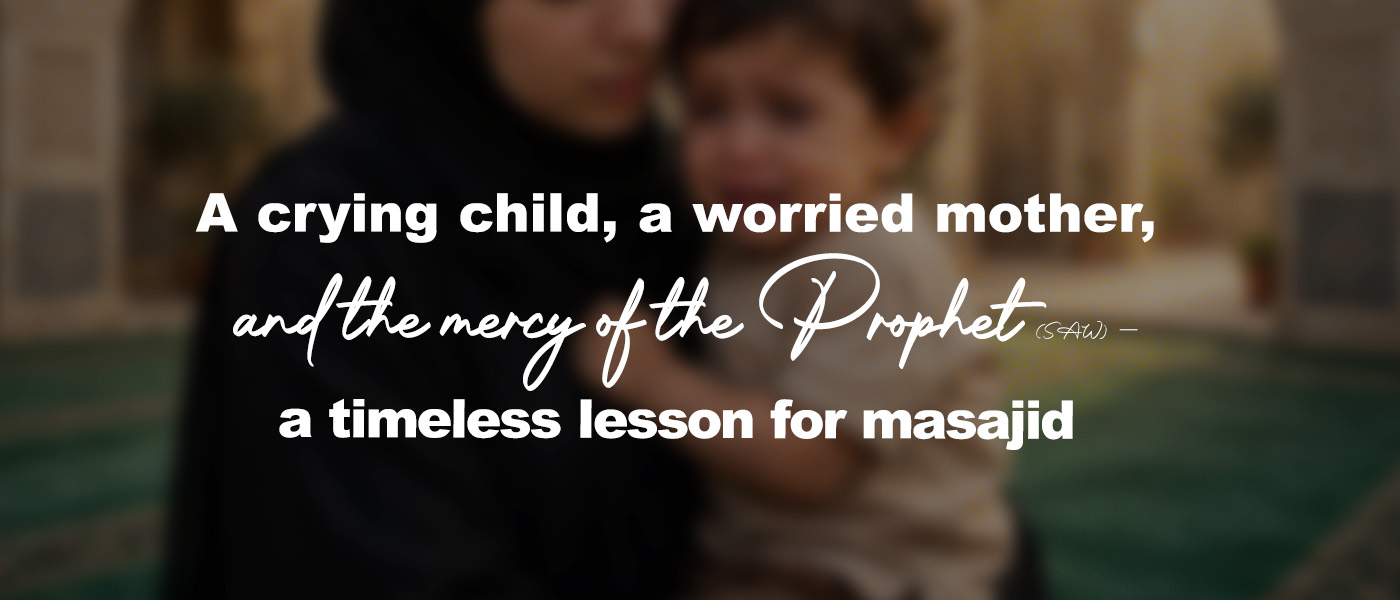
Among the many moments preserved from the life of the Prophet Muhammad (SAW) are those that show how deeply he (SAW) understood the feelings and circumstances of the people around him. His mercy appeared not only in major events but also in ordinary moments of worship, family life, and community. One moving example is when he (SAW) shortened the congregational prayer after hearing a child crying, knowing the mother would be distressed.
Anas ibn Malik (ra) reported that the Prophet (SAW) said, “Indeed, I enter the prayer intending to prolong it, but then I hear the crying of a child, so I shorten my prayer because I know how deeply his crying troubles his mother.” (Sahih Bukhari) Even while leading one of the greatest acts of worship, he (SAW) remained attentive to the emotional state of a mother praying behind him. This moment shows that worship in Islam is inseparable from mercy, wisdom, and awareness of others’ needs.
It also shows what the mosque was like during his time: a place where real people came with real responsibilities. Mothers attended with their children, babies cried, and people entered prayer carrying the circumstances of daily life. A small adjustment made out of compassion carried great meaning, and his (SAW) example continues to speak to families and communities today.
Are our masajid welcoming spaces for women and new mothers?
The example of the Prophet (SAW) should make us reflect seriously on the experience of women in some masajid today. If he (SAW) was attentive enough to consider a mother’s distress during salah, then our communities should ask whether we show similar awareness toward the women who enter our masajid.
In many places, women—especially mothers with infants and young children—feel their needs were considered only after everything else was planned. Men may pray in a spacious, well‑maintained area while women are directed to a smaller room with poor ventilation, an unreliable sound system, limited access to the imam, or inadequate facilities for mothers and children. A mother may arrive carrying a baby, a diaper bag, and a stroller, only to find nowhere comfortable to nurse, change her child, or calm a crying baby.
Often, this is not deliberate neglect. Women’s needs were simply never included in the decision‑making process. When women are absent from these conversations, their absence from the masjid may later be misinterpreted as lack of interest, when the environment itself may have made participation difficult.
There can also be cultural discomfort surrounding motherhood in communal spaces. A crying child may be treated as a disturbance rather than part of community life. A mother may feel embarrassed when her baby makes noise or pressured to leave before anyone offers help. Yet the prophetic example gives us a different picture: the Prophet (SAW) centered the mother’s experience.
Even communities with limited finances can ask whether mothers feel welcomed, whether volunteers assist them, whether changing facilities are clean and accessible, whether women can hear and follow the prayer properly, and whether a mother with a restless child is met with understanding rather than disapproval. The Prophet (SAW) said, “Do not prevent the female servants of Allah from the mosques of Allah.” (Sahih Muslim)
The deeper question is whether the mercy shown by the Prophet (SAW) can actually be felt when women arrive.
What do we lose when the mothers of our community stop coming to the masjid?
When mothers stop coming to the masjid, the loss affects the entire community. A masjid is part of the spiritual and social life of the Ummah, and when mothers feel unable to participate consistently, a vital part of that communal life weakens.
For mothers, regular connection to the masjid provides support that is difficult to replace. It may be where they attend classes, hear reminders that renew their faith, meet other Muslim women, ask questions, or simply experience the comfort of worshiping among believers. Early motherhood can be physically demanding and socially isolating. If the masjid becomes another place that feels difficult to enter, she may lose access to spiritual and communal support at a time she needs it most.
Her children are affected as well. A child’s relationship with the masjid begins through familiarity: recognizing the building, the prayer rugs, the sound of the adhan, the people who greet them, and the feeling that this is a place where their family belongs. These early experiences shape a child’s emotional connection to Islam. When attending the masjid becomes stressful for a mother, these experiences may happen less often, and children may grow up seeing the masjid mainly on major occasions rather than as a natural part of Muslim life.
The masjid also loses the contributions of women—knowledge, professional experience, creativity, service, mentorship, and insight into the needs of families. Mothers often see the community through multiple perspectives at once: their own, their children’s, and their wider family’s. When their voices are missing, decisions may overlook the needs of a significant part of the congregation.
Communities often speak about wanting young Muslims to love the masjid and remain connected to Islam as they grow older. That connection begins early, through repeated experiences of belonging. When a mother can bring her children into a masjid where they are treated with patience and warmth, the community is helping shape the next generation’s relationship with the house of Allah (SWT).
Our responsibility as Muslim communities
This particular story of the Prophet’s (SAW) actions is powerful because of its simplicity. It reminds us that mercy, attentiveness, and emotional intelligence were woven into the way he (SAW) led the community.
A mother should not have to choose between caring for her child and feeling welcome in the house of Allah (SWT). The Prophet (SAW) showed that mercy does not weaken worship; it gives worship its proper character. His concern for a mother became part of the wisdom with which he (SAW) led the prayer.
If our masajid are to reflect the Prophetic model, then mothers must be seen, heard, and considered. Their presence should not be treated as an inconvenience, and their children should not be viewed merely as disruptions. They are part of the community, and the way we treat them today may shape how an entire generation understands its relationship with the masjid tomorrow.
Sometimes the clearest measure of a community’s mercy is not found in what it says, but simply in how it responds when a child begins to cry.
Dua
May Allah (SWT) make our masajid places of mercy, dignity, and belonging for every believer. May He (SWT) grant our imams, leaders, and communities the wisdom to recognize the needs of women, mothers, children, and families with the compassion taught by His Messenger (SAW).
May He (SWT) ease the burdens of mothers, strengthen them in faith, reward their sacrifices, and never allow them to feel forgotten in the houses built for His worship.
May He (SWT) raise our children with love for the masjid, surround them with gentleness, and make our communities a reflection of the mercy and care embodied by the Prophet (SAW).
Ameen!