A mountain of gold, and a river of blood: The prophecy of the Euphrates during the final Hour
October 6, 2026
Have you ever noticed that there is something about wealth that has always had the ability to capture the attention of the human mind and heart every single time? A person may have enough to eat, they will have a comfortable home, clothes to wear, and money saved away, yet still they’ll find themselves looking toward what he does not have and actively yearning for it. More money, a larger house, a newer car, a more luxurious lifestyle—the world constantly whispers that happiness is somewhere just beyond what we currently possess, and if we can only acquire a little more, then perhaps we will finally feel satisfied. Yet anyone who has lived long enough knows how quickly that promise disappears. What once seemed like a dream becomes ordinary, and the heart begins searching for the next thing. Islam has never taught us that wealth itself is evil.
Allah (SWT) has permitted His servants to earn, trade, build, own, give, and enjoy what is lawful. The danger begins when the dunya stops sitting in the hand and begins settling inside the heart. When wealth becomes more than a means and turns into an obsession, people begin measuring their worth by what they own and their success by what they can accumulate. Relationships can be sacrificed for it. Families can be divided for it. Principles can be abandoned because of it. Men who once spoke about loyalty may betray one another when enough money is placed between them, and people who appeared content can suddenly reveal a hunger that no amount of gold could ever satisfy.
In The Quran, Allah (SWT) says, “The enjoyment of worldly desires—women, children, treasures of gold and silver, fine horses, cattle, and fertile land—has been made appealing to people. These are the pleasures of this worldly life, but with Allah is the finest destination.” (The Clear Quran®, 3:14) This verse emphasizes the concept of attraction. It speaks to the pull these things have upon the soul and reminds us that, however impressive they may appear, they belong to a world that is passing away.
Perhaps one of the greatest illusions people live with is the belief that humanity will eventually outgrow this obsession. We imagine that after enough wars, enough corruption, enough broken families, and enough lives ruined in the pursuit of money, people will finally understand how little this world is worth. Yet the teachings of the Prophet Muhammad (SAW) paint a far more sobering picture. Even as this world approaches some of its final chapters, and even as extraordinary signs begin unfolding before mankind, the desire for wealth will not simply disappear. For many people, it will become so powerful that they will be prepared to risk everything for the possibility of possessing it. This should make every believer think carefully about the condition of their heart. It is easy to speak about the dangers of greed when the temptation is small. It is easy to say that money does not matter when nothing enormous has been placed before us.
However, what happens when wealth appears in a form so astonishing that people travel toward it from every direction? What happens when the promise of riches becomes so great that human life itself begins to look cheap beside it? The Prophet (SAW) warned his Ummah about such a time. He spoke of an event connected to wealth on a scale difficult to imagine, an event in which something hidden would be uncovered and people would descend upon it with hopes of fortune. What follows would expose just how far human beings can go when the love of this dunya overwhelms the fear of Allah (SWT), concern for the akhirah, and even the instinct to preserve their own lives.
This article will discuss the story of a mountain of gold, the blood that will be spilled all around it, and the five important lessons we can learn from this hadith.
What will be the Battle of the Mountain of Gold?
This warning concerning the mountain of gold is not based on folklore, rumor, or later Muslim storytelling. It comes directly from an authentic hadith attributed to the Prophet Muhammad (SAW), and the wording is severe enough that it deserves to be read carefully rather than treated as another dramatic story about the End Times. Abu Hurayrah (ra) narrated that the Messenger of Allah (SAW) has said, “The Hour will not be established until the Euphrates uncovers a mountain of gold, over which people will fight. Ninety-nine out of every hundred will be killed, and every man among them will say, Perhaps I will be the one who survives.’” (Sahih Muslim)
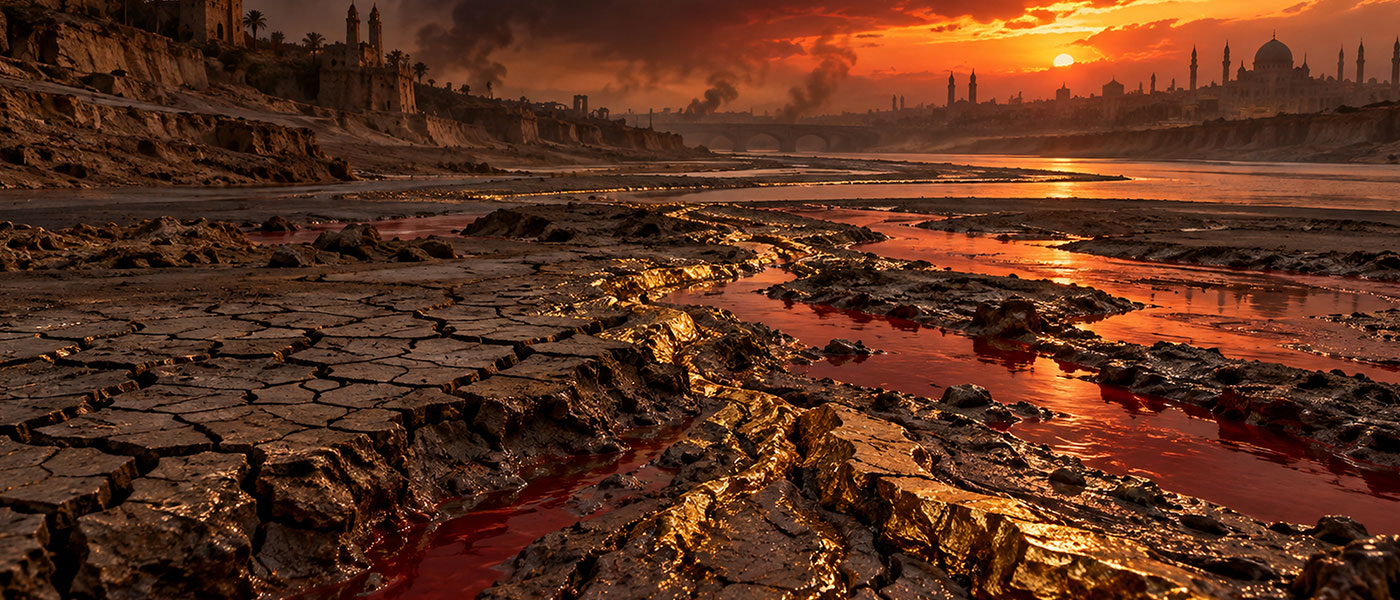
A closely related narration also appears in Sahih Bukhari in which the Prophet (SAW) warned that the Euphrates would uncover a treasure of gold and instructed whoever witnessed it not to take anything from it. The final instruction is perhaps one of the most important details in the entire narration. The Prophet (SAW) did not tell the believers to rush toward wealth. He did not describe it as a great opportunity for a blessing to be seized. Instead, he warned against taking it altogether. Whatever is uncovered will be surrounded by such greed, conflict, and bloodshed that avoiding it will itself become an act of obedience and protection. The hadith also gives us a chilling picture of human psychology. Imagine a conflict in which 99 out of every 100 people are killed. The scale of death would be obvious to everyone involved. Men would also see those around them falling, families would be destroyed, and the danger would no longer be theoretical. Despite all of that, people would still tell themselves that perhaps they would be the exception. Perhaps everyone else would die, but they would survive. Perhaps they would be the one who walked away with the gold.
That is what makes this narration a warning about the greed of the human heart. Further, the mention of the Euphrates is also significant. The Prophet (SAW) identified a specific river and connected it to a specific event that would occur before the Hour. However, Muslims should be careful not to force every modern development involving the Euphrates into this hadith. Whenever water levels fall, resources are discovered, or political tensions increase in the region, people sometimes immediately claim that the prophecy has been fulfilled. However, we see that our Prophet (SAW) has clearly outlined what will be taking place should that happen. For that reason, it is wiser to affirm what the Prophet (SAW) said without confidently attaching the hadith to events that do not clearly match its description. The believer does not need speciation to make the narration powerful; the words themselves suffice.
Major lessons to learn from this hadith
1. Greed can blind a person to ultimate destruction

The first lesson from this hadith is that greed can become so powerful that it blinds a person even when the danger in front of him is undeniable. The Prophet (SAW) described a situation in which 99 out of every 100 people involved in the fighting would be killed, yet each person would still convince himself that he might be the one who survives. That is not merely a description of violence. It is a frightening description of what happens to the human mind when desire takes control of the heart. Normally, a person would think that seeing such destruction would be enough to make anyone turn away. If nearly everyone who reaches for a treasure is killed, then reason should tell a person to leave it alone. Yet the hadith shows us that greed does not always listen to reason. Once a person becomes consumed by what he wants, he can begin making exceptions for himself. He sees what happened to everyone else, but tells himself that his outcome will be different. He knows the risk, but desire makes the reward seem larger than it already is.
This is not only a lesson for some distant generation that may witness the Euphrates uncovering its gold. The same weakness appears in smaller forms throughout everyday life. People destroy families over inheritance, betray friends over money, enter forbidden transactions for profit, and compromise their religion for status or financial security. In many of these cases, the person knows there is a price to pray, but convinces himself that the gain will somehow be worth it. The hadith therefore teaches us to fear unchecked attachment to the dunya before it reaches that point. Wealth should remain something we possess, not something that possesses us. The believer asks Allah (SWT) for halal provision, benefits from what He has given, and remains grateful for His blessings, but He also understands that no amount of gold is worth sacrificing obedience, brotherhood, or the akhirah.
The people who fight over the mountain of gold will not necessarily be ignorant of the danger. According to the hadith, they will see the destruction around them and continue anyway. That is what makes the warning so serious. Sometimes the greatest danger is not failing to recognize the truth, but recognizing it and still allowing your desire to overpower it. A heart that has learned contentment is far safer than a heart that is always asking for more.
2. Not every opportunity is a blessing—be careful

Another important lesson from the hadith is that not every opportunity that appears valuable is actually good for us. Human beings naturally associate abundance with blessing. If something promises wealth, success, influence, or security, we often assume that pursuing it must be worthwhile. However, the mountain of gold teaches us the opposite. Something can look like the opportunity of a lifetime and still become a source of destruction. The people in the hadith will see immense wealth before them, yet the Prophet (SAW) warned those who see it not to take from it. That instruction should make us think carefully about how we judge opportunities in our own lives. The value of something is not determined only by how much money it brings, how impressive it looks, or how rare the chance seems. The believer must also ask what it will cost spiritually, morally, and personally.
There are opportunities that increase a person’s wealth while weakening his relationship with Allah (SWT). There are promotions that come with compromises, business deals that depend on what is haram, and financial gains that create more anxiety than peace. There are also situations where the promise of success becomes so attractive that a person ignores warning signs he would normally recognize immediately. The hadith of the mountain of gold reminds us that abundance itself is not proof of divine favor. Sometimes being given access to something is a test rather than a reward. Allah (SWT) may test a person through hardship, but He can also test him through wealth, comfort, and opportunity. The question that a person must reflect on is, “What will this do to my heart, my faith, and my obedience to Allah (SWT)?”
This is why the command of the Prophet (SAW) is so powerful. The gold, opportunity, and temptation will be very real things, but the correct response will still be to walk away. In a world that constantly tells us to seize every chance before someone else does, Islam teaches us that sometimes the strongest decision is restraint. Believers do not measure success only by what they manage to acquire. Sometimes success is recognizing what must be left behind.
Remember, Allah (SWT) has said in The Quran, “Fighting has been made obligatory upon you believers, though you dislike it. Perhaps you dislike something which is good for you and like something which is bad for you. Allah knows and you do not know.” (The Clear Quran®, 2:216)
3. Signs of the Hour are meant to guide us, not entertain us

There is a tendency when discussing the signs of the Day of Judgment to become fascinated with the event itself. People want to know when it will happen, what it will look like, where exactly it will take place, and whether something happening in the world today might be its beginning. However, the hadith of the mountain of gold reminds us that the Prophet (SAW) did not teach his Ummah about the future merely to satisfy curiosity. He taught us that we would know how to respond. This gives us an important lesson on how we should approach all discussion about the End Times.
The value of knowing about a sign is not found in being able to speculate about dates, produce dramatic theories, or connect every major event in the Muslim world to a prophecy. The real benefit is found in asking what that knowledge is supposed to change within us. Does it increase our fear of Allah (SWT)? Does it make us less attached to the dunya? Does it strengthen our obedience? Does it make us more conscious of the fact that this world is moving toward an appointed end?
Allah (SWT) has said, “The Hour has drawn near and the moon was split in two.” (The Clear Quran®, 54:1)
The Quran repeatedly speaks about the nearness and certainty of the Hour not as trivia about the future, but as a warning to people living in the present. Knowledge of what is coming is supposed to awaken the heart before it arrives. The mountain of gold is a perfect example of this. A Muslim does not need to know exactly when the Euphrates will uncover it in order to benefit from the hadith today. The warning already has something to teach us. The Prophet (SAW) has shown us what unchecked greed can lead to, how dangerous worldly temptation can become, and what the believer should do if that particular trial ever appears.
There is therefore something misplaced about becoming obsessed with identifying the mountain while neglecting the command connected to it. A person could spend years studying maps, river levels, political developments, and theories about the Euphrates while failing to address the same love of wealth within his own heart that the hadith warns against. The signs of the Hour were not revealed so that Muslims could become spectators waiting for a prophecy to unfold. They were revealed so that we would prepare ourselves for meeting with Allah (SWT), and preparation begins long before the mountain of gold ever appears.
4. Just because thousands of people may follow something, doesn’t mean they are right
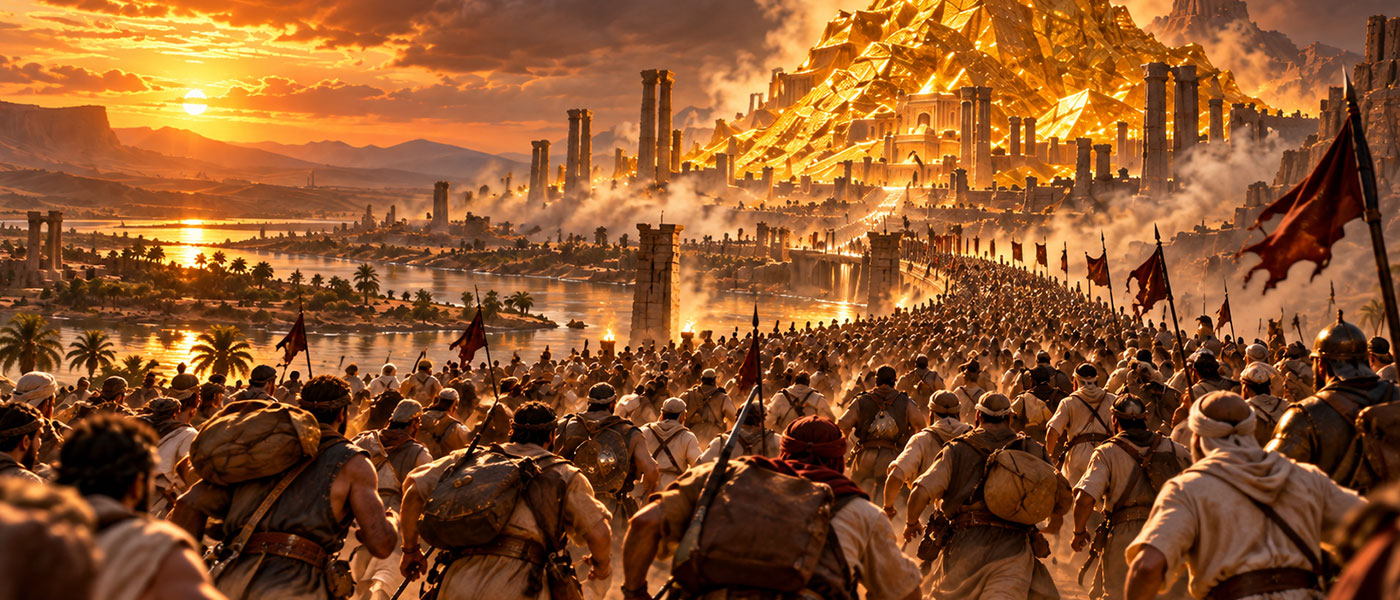
Another remarkable lesson from the hadith is that large numbers do not make a decision wise, safe, or pleasing to Allah (SWT). The people who gather around the mountain of gold will not be acting alone. They will be surrounded by others who want the same thing, fear missing out on the same opportunity, and are willing to take the same risks. In that kind of environment, the behavior of the crowd can begin to make something dangerous feel normal. Human beings are deeply influenced by what they see others doing. When everyone around us is chasing the same goal, making the same compromise, or accepting the same behavior, it becomes easier to assume that it must be reasonable. A person may hesitate at first, but once he sees thousands of others rushing forward, his caution can begin to weaken. The question quietly changes from, “Is this right” to, “Why should I be the only one who stays behind?”
The hadith of the mountain of gold exposes the danger of that thinking. The crowd will not protect anyone from the consequences. In fact, the crowd itself will become part of the disaster. People will gather because of the gold, compete because of the gold, and eventually fight because of the gold. What begins as a collective desire will turn into collective destruction. This is a lesson that applies far beyond the specific event described in the hadith. There will always be moments when the values of the people around us conflict with what Allah (SWT) has commanded. A society may normalize something, a marketplace may reward something, or an entire community may become comfortable with a behavior that is spiritually harmful. The believer cannot make truth dependent on popularity.
Allah (SWT) says in The Quran, “O Prophet! If you were to obey most of those on earth, they would lead you away from Allah’s Way. They follow nothing but assumptions and do nothing but lie.” (The Clear Quran®, 6:116)
Imagine standing before enormous wealth while everyone around you is moving toward it. Imagine hearing people speak about the opportunity, seeing others rush forward, and feeling the pressure of being left behind. In that moment, obedience may require doing the exact opposite of what nearly everyone is doing. That is one of the qualities of sincere faith, and that is the ability to remain anchored when the crowd is moving in another direction.
5. Following the orders of our Prophet (SAW) is our salvation, and to go against it is our damnation
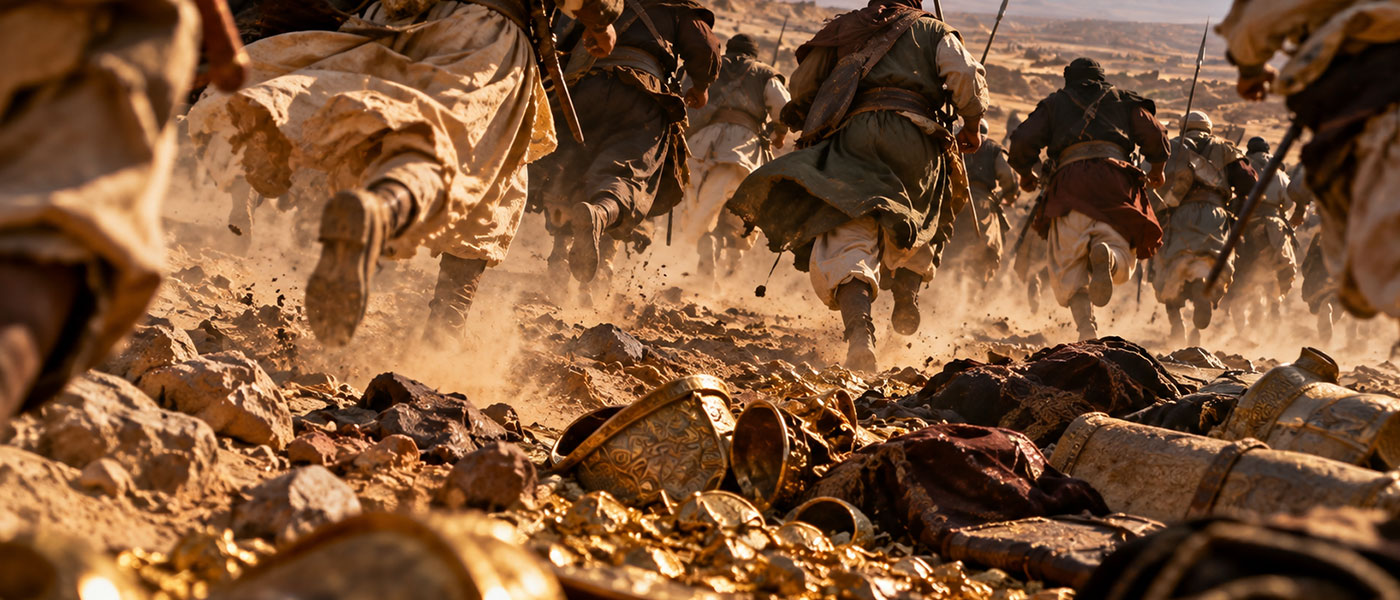
At the Battle of Uhud, the Prophet (SAW) stationed a group of archers on a strategic hill and instructed them not to leave their position, regardless of whether the Muslims appeared to be winning or losing. At one point in the battle, the Muslims seemed to have gained the upper hand, and some of the archers saw the spoils of war being collected below. Believing that the battle was effectively over, a number of them left their assigned position despite the warning of their commander. The Quran later addressed what happened.
Allah (SWT) said, “Indeed, Allah fulfilled His promise to you when you initially swept them away by His Will, then your courage weakened and you disputed about the command and disobeyed, after Allah had brought victory within your reach. Some of you were after worldly gain while others desired a heavenly reward. He denied you victory over them as a test, yet He has pardoned you. And Allah is Gracious to the believers.” (The Clear Quran®, 3:152)
The companions of the Prophet (SAW) who joined him in this battle were the best generation of his Ummah, and Allah (SWT) taught the believers through what happened that day. However, The Quran itself identifies worldly desire as one of the factors present in that moment. The consequences were severe. The opening created by the archers leaving their position was exploited, the course of the battle changed dramatically, and the Muslims suffered tremendous losses. What appeared to some as an opportunity to collect something from the dunya became part of a much greater trial.
This moment in history gives the hadith of the mountain of gold an additional weight. Centuries before that future event takes place, the Ummah was already taught that worldly desires can interfere with obedience at precisely the moment when obedience matters most. At the Battle of Uhud, the temptation involved the spoils of battle. Near the end of time, the temptation described by the Prophet (SAW) will be on an unimaginable scale. There is also something humbling in this comparison. If members of the earliest Muslim community could be tested by the attraction of worldly gain, then later generations have no reason to feel immune. The correct response is not to look back at the Battle of Uhud with superiority, but to recognize how vulnerable the human heart can be and how urgently it needs discipline.
Dua
May Allah (SWT) protect our hearts from becoming attached to the dunya, grant us contentment with what He has provided, and keep wealth in our hands without allowing it to settle in our hearts. May He protect us from greed, envy, unlawful gain, and every fitnah that distances us from Him.
May Allah (SWT) grant us the wisdom to recognize temptation for what it is, the strength to obey Him when obedience is difficult, and the sincerity to choose the Hereafter over whatever this world places before us. May He protect us from the trials of the end times, keep us firm upon The Quran and the Sunnah, and allow us to meet Him with hearts that are sound.
O Allah! Do not make this dunya our greatest concern, nor the limit of our knowledge. Forgive our sins, guide our families, increase us in iman, and grant us a beautiful ending upon Islam.
Ameen, ya Rabb!