
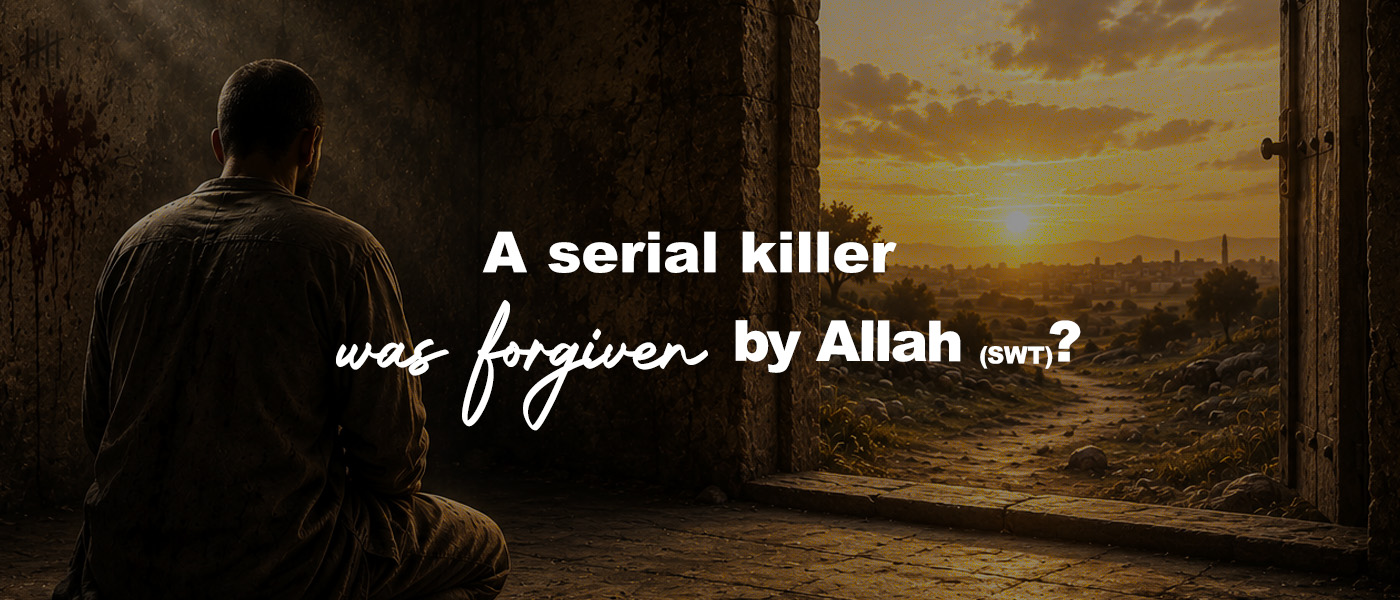
There are some sins so grave that, from a human perspective, forgiveness can seem almost unimaginable. The Prophet (SAW) told us about a man who had killed 99 people, a man whose past was not only troubled or sinful, but downright horrifying. He had taken life after life, and there was no way for him to undo what he had done. Yet despite the enormity of his crimes, something within him had not completely died—he wanted to know whether repentance was still possible from Allah (SWT). That question lies at the heart of this remarkable hadith. It is not a story that asks us to overlook murder, soften its seriousness, or forget the rights of those who were wronged. The man’s crimes remain monstrous. What the hadith reveals, however, is that even a person buried beneath an extraordinary amount of sin is not permitted to despair of Allah’s (SWT) mercy. The distance between a servant and his Lord is not measured only by the darkness of what has already happened, but also by the sincerity with which that servant turns back.
The man began searching for someone who could tell him whether Allah (SWT) would accept his repentance. His first encounter ended disastrously. He was given an answer that closed the door of hope before him and, in his rage, he killed once again, bringing his number of victims to 100. Yet even then, his desire to repent remained. He continued searching until he was directed to a man of knowledge who gave him a very different answer. Yes, there was a way back to Allah (SWT), but the repentance would require more than regret. He would have to leave the corrupt environment in which he had lived, separate himself from the people and circumstances that had sustained his evil, and begin moving toward a place where righteous people worshiped Allah (SWT). So he left. He set out not as an innocent man, and not as someone whose past had suddenly vanished, but as a guilty man sincerely trying to change the direction of his life. He died before reaching the land he was traveling toward and it was there, between the place he had left and the place he hoped to reach, that the true meaning of his repentance was revealed.
The story of the man who killed 100 people is one of the most powerful accounts of tawbah in the Sunnah because it holds two truths together without weakening either one. Sin can be devastatingly serious, and Allah’s (SWT) mercy can still be greater. A person may have gone terribly far in the wrong direction, but while life remains, the path back to Allah (SWT) has not necessarily disappeared. The question is whether he will truly turn around and begin walking toward Him. Below are five major lessons that we can take away from this story, and use as reminders in our own lives.
1. No sin is greater than the mercy of Allah (SWT)
The first and most obvious lesson from this hadith is also one of the most important truths a Muslim can ever understand, and that is, no matter how enormous a person’s sins become, he must never believe that Allah’s (SWT) mercy is beyond his reach. This man had killed 100 people. The hadith does not present him as someone guilty of a small mistake, a moment of weakness, or a private sin known only to Allah (SWT). He had repeatedly committed one of the gravest crimes a human being can commit. Human lives had been taken by his hands, and nothing he did afterward could bring those people back. If there were ever a person who might have looked at his past and concluded, “There can be no forgiveness for someone like me,” it would have been him. Yet the Prophet (SAW) tells us that the door of repentance was still open. This is exactly the principle Allah (SWT) establishes in The Quran when He says, “Say, O Prophet, that Allah says, ‘O My servants who have exceeded the limits against their souls! Do not lose hope in Allah’s mercy, for Allah certainly forgives all sins. He is indeed the All-Forgiving, Most Merciful.’” (The Clear Quran®, 39:53)
Despair can therefore become one of Shaytan’s most dangerous weapons against a sinner. After convincing a person to disobey Allah (SWT), he may then try to convince him that there is no point in returning. He whispers that the past is too ugly, the sins are too numerous, and repentance would be hypocritical after everything that has happened. In this way, a person can become trapped not only by his sins, but by the belief that he is no longer worthy of seeking forgiveness. The story of the 100 murders destroys that idea completely. If a man responsible for 100 deaths was not told that repentance was impossible, then no ordinary sinner should appoint himself judge over Allah’s (SWT) mercy and declare his own case hopeless. A person may feel ashamed before Allah (SWT), and that shame may even help awaken repentance, but shame should drive him toward Allah (SWT), not away from Him.
At the same time, Allah’s (SWT) mercy should never be misunderstood as permission to take sin lightly. The lesson is not that sins do not matter. The very fact that repentance is necessary shows that they matter enormously. Rather, the lesson that however serious the sin may be, the sinner should never allow its seriousness to make him despair of the One who forgives it. A Muslim lives between fear and hope—fear of his sins and their consequences, but hope in the mercy of his Lord. This hadith teaches us that even when the record of the past is terrifying, the servant should still turn toward Allah (SWT). The size of the sin does not determine the limits of Allah’s (SWT) mercy. Allah (SWT) does.
2. Sincerity is not enough, you need sound knowledge
One of the clearest lessons in this story is the danger of seeking religious guidance from someone who does not have the knowledge to give it. When the man wanted to know what he should do, he first asked about the most devoted worshipper in the land. He was directed to a monk, and he asked him whether repentance was possible after killing 99 people. The monk said no. The answer was disastrous. The man killed him as well, bringing the number to 100. The problem was not that the monk lacked devotion. He may have been deeply religious and sincere in his worship. The problem was that devotion and scholarship are not the same thing. A person can be righteous, disciplined, and well-intentioned while still being unqualified to answer difficult religious questions. The man then asked again, but this time he was directed to a man of knowledge. That distinction in the hadith is important because the scholar understood the matter correctly and gave guidance that was both religiously sound and practically useful. This teaches us that when serious questions arise, especially questions involving halal and haram, repentance, family matters, financial dealings, rights, obligations, or major life decisions, we should not simply ask whoever appears most religious. We should seek people who actually possess knowledge, understanding, and the ability to apply Islamic principles correctly.
Allah (SWT) says, “We did not send messengers before you O Prophet except mere men inspired by Us. If you polytheists do not know this already, then ask those who have knowledge of the Scriptures.” (The Clear Quran®, 16:43)
This principle is especially important today because religious advice is available everywhere. A person can hear a confident answer in a short video, read an anonymous comment online, or receive a ruling from a friend who means well but has never studied the issue properly. Confidence can easily be mistaken for knowledge, and outward religiosity can easily be mistaken for qualification. The hadith teaches us not to make a distinction. A good person or a powerful speaker are not automatically scholars. Someone who memorizes quotations isn’t either, and someone who gives the strictest answer is not necessarily the most knowledgeable. Sound Islamic guidance requires knowledge of The Quran and Sunnah, understanding of the principles by which they are interpreted, and wisdom in applying them to the situation at hand.
There is also a warning here for those who are asked religious questions. Saying “I do not know” is not a weakness. It can be an act of honesty and fear of Allah (SWT). Giving an answer without knowledge, however, can have consequences far beyond the person speaking. The first man in the story answered a question he was not equipped to answer. The second understood what he was dealing with. The lesson is simple but serious: when your religion is at stake, do not merely look for someone who seems pious. Look for someone who knows.
3. Sometimes you have to leave the environment that keeps pulling you back
The scholar did not simply tell the man that he could repent. He also told him to leave the land in which he was living and go to another place where righteous people worshipped Allah (SWT). That detail is not incidental, it teaches us that changing ourselves often requires changing what surrounds us. The man had spent his life in an environment connected to his violence and corruption. Whatever influences, habits, relationships, or circumstances had helped sustain that life could not simply be ignored. If he remained in the same place, among the same influences, following the same patterns, he would be placing himself back inside the world that had helped produce the person he was trying to leave behind. So he was told to go somewhere else.
This is one of the most practical lessons in the entire hadith. People often want to change while keeping everything around them exactly the same. They want to abandon a sin while continuing to spend time in the places where they commit it, remain surrounded by people who encourage it, consume the same things that awaken the desire for it, and maintain routines built around it. Then they are surprised when the old behavior returns. Islam recognizes that the human being is affected by his surroundings. The Prophet (SAW) has said, “A person who follows the way of his close friend, so let each of you consider whom he takes as a close friend.” (Sunan Abi Dawud)
The people around us influence what we normalize, what we laugh at, what we tolerate, what we desire, and eventually what we become. The same is true of the places we frequent, the content we repeatedly consume, and the routines we build into our lives. For one person, leaving a harmful environment may mean distancing himself from friends who constantly draw him toward sin. For another, it may mean deleting an app that repeatedly leads him into something haram. Someone else may need to stop going to a particular place, leave a destructive relationship, change a social circle, or rebuild an entire daily routine. Not everyone needs to physically move to another city, of course. The principle is broader than geography. The point is that we should not knowingly keep ourselves surrounded by the very conditions that repeatedly weaken us.
There is also wisdom in what the scholar told the man to move toward. He was not merely told to leave a bad place, he was told to go to a place where people worshipped Allah (SWT). Removing corruption is only half the task. A person needs something better to replace it. Good company, beneficial routines, worship, and a healthier environment can help reinforce the change a person is trying to make. That is why meaningful change is often not just a matter of saying, “I will be stronger next time.” Sometimes the wiser response is to make sure that next time looks completely different. The lesson is clear that if an environment repeatedly pulls you toward disobedience, part of protecting your faith may be having the courage to leave it behind.
4. A sincere intention must always be followed by sincere action
The man did not stop at wanting a different life. Once he was shown what he needed to do, he acted, and he left. That matters because many people genuinely dislike what they have become, regret what they have done, and even wish they were different, but never take the first concrete step toward change. They remain in the realm of intention, reflection, and emotion. The hadith shows us that sincerity begins to reveal itself when a person is willing to move. The man was told to go to another land, and he set out toward it. He did not know whether he would reach it. He did not know how much time he had left. He simply began walking in the direction he had been told was better. Then he died on the way. That is one of the most striking parts of the story, he had not yet arrived, he had not completed the journey, he had not lived for years among righteous people or built a long record of good deeds after his crimes. But he had begun moving away from the life he wanted to abandon and toward the life he wanted to live.
The Prophet (SAW) described how the angels of mercy and the angels of punishment disputed over him, until Allah (SWT) caused the matter to be decided in his favor because he was closer to the land toward which he had been travelling. The image is powerful, that his direction mattered. This teaches us something deeply practical. We may not always be able to repair everything immediately. We may not become the person we want to be overnight. We may not live long enough to complete every good intention we carry. But once we know what is right, we should begin moving toward it. A person who wants to learn The Quran should begin with the first lesson. A person who wants to repair his prayers should start guarding the next one. A person who needs to return something he wrongfully took should begin making arrangements to return it. A person who owes an apology should stop rehearsing it endlessly and give it. A person who wants to leave a sinful habit should take the first real step that makes returning to it more difficult.
Islam does not ask us to wait until we feel perfectly ready. Allah (SWT) says in The Quran, “[…] and that each person will only have what they endeavoured towards […].” (The Clear Quran®, 53:39) There is also hope here for anyone who feels overwhelmed by how far he still has to go. You may not have completed the journey yet. You may still be weak, inconsistent, and far from where you want to be. What matters is that you stop standing still. The man in this hadith died on the road, but he died facing the right direction. That is the lesson that do not wait until you can finish everything before you begin. Once you know the path is right, start walking.
5. Repentance does not make the rights of other people disappear
The extraordinary mercy shown to the murderer in this hadith should never lead us to a careless conclusion that because Allah (SWT) may forgive a sinner, the harm he caused to other people no longer matters. This man had taken 100 lives. His repentance was accepted by Allah (SWT), but the hadith does not tell us that murder suddenly became a small matter, that the victims were unimportant, or that their rights ceased to exist. The story is about the possibility of a sinner returning to Allah (SWT), it is not a declaration that crimes against people are without consequences. This distinction is essential in Islam because sins are not all of the same kind. Some acts of disobedience concern primarily the servant’s relationship with Allah (SWT), while others involve the rights of other human beings. When another person has been wronged, repentance includes taking those rights seriously.
The Prophet (SAW) gave a powerful warning about this, “Whoever has wronged his brother with regard to his honor or anything else, let him seek to be released from it today, before there will be neither dinar nor dirham.” (Sahih Bukhari)
The Prophet (SAW) went on to explain that on the Day of Judgment, a person’s good deeds may be taken from him and given to those he wronged. If his good deeds are exhausted, the sins of those he harmed may be placed upon him. This means that tawbah is not simply a private feeling between a person and Allah (SWT) when the sin has damaged someone else. If money was stolen, it should be returned. If a debt is owed, it should be paid. If property was taken, it should be restored. If someone’s reputation was unjustly damaged, the wrong must be addressed in whatever manner Islamic guidance requires. Where there are legal rights and punishments involved, those matters have their own rulings and should be handled according to qualified Islamic and lawful authority.
That is an important balance to preserve when reading the story of the hundred murders. We should marvel at the mercy of Allah (SWT) without becoming indifferent to justice. In fact, the hadith becomes even more powerful when we keep the seriousness of the victims’ rights in view. Allah (SWT) did not forgive this man because what he had done was insignificant. What he had done was unimaginably grave. The greatness of the story lies precisely in the fact that Allah’s (SWT) ability to accept sincere repentance is not limited by the enormity of the servant’s past. At the same time, the sinner himself should never use Allah’s (SWT) mercy as a way of escaping responsibility. Genuine repentance produces humility. A person who truly recognizes his wrongdoing does not merely say, “Allah will forgive me,” and then ignore the people whose lives he has damaged. He should be concerned with correcting whatever can still be corrected.
There are some consequences, of course, that cannot simply be reversed. A word cannot always be unheard, years cannot be returned, a life that has been taken cannot be restored in this world. In such cases, the inability to undo the past should make a person more humble before Allah (SWT), not less concerned about what he has done. The lesson, then, is one of balance—never despair of Allah’s (SWT) forgiveness, but never use Allah’s (SWT) forgiveness to trivialize another person’s rights. Mercy and justice are not opposites in Islam. We are commanded to hope for the first while taking the second with absolute seriousness.
Dua
O Allah! Forgive us all of our sins—the small and the great, the first and the last, those committed openly and those committed in secret.
O Allah, grant us sincere and genuine repentance before death, and do not make us among those who despair of Your mercy. Guide us to what pleases You, help us leave everything that takes us away from You, and bless us with righteous companions and an environment that helps us obey You.
O Allah! Help us restore the rights of those we have wronged and repair whatever harm we are able to repair.
Ameen!