Are non-Muslims welcome in mosques? A story from the Prophet Muhammad’s (SAW) blessed life
September 11, 2026
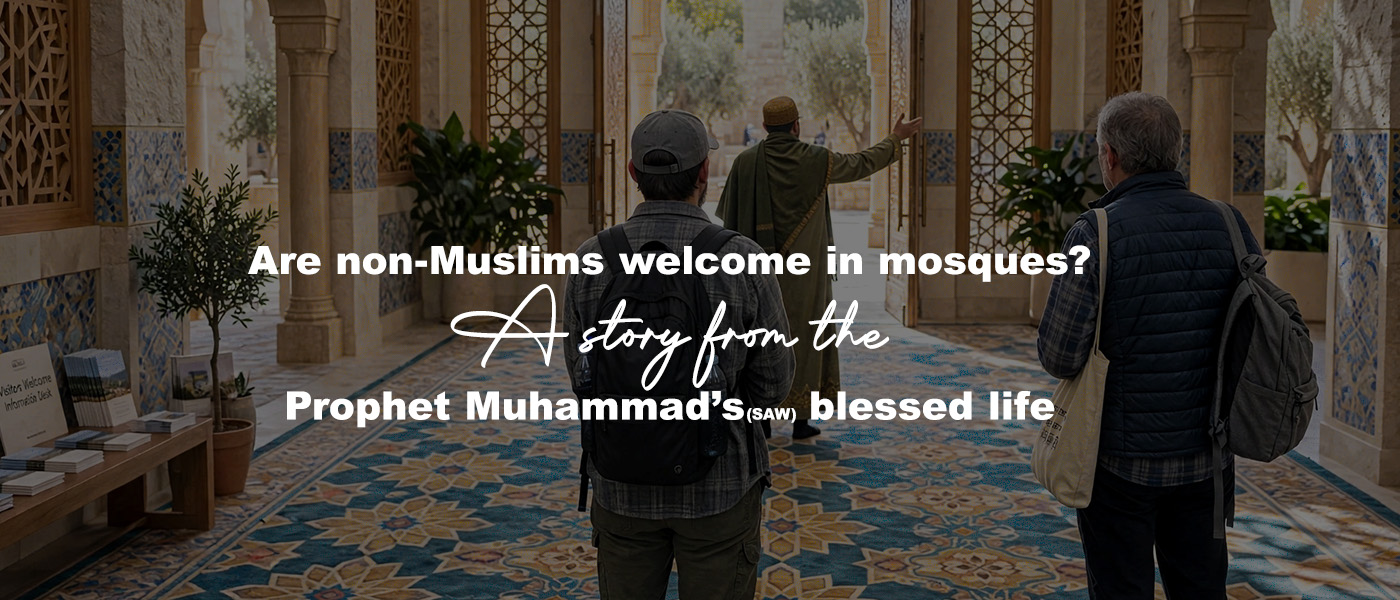
Have you ever wondered what your experience would be like if you were not born a Muslim, and then stepped foot into a mosque for the first time? You’ve never heard the adhan before, you do not know where to leave your shoes, whether you should sit or stand (or where you should sit or stand), which direction everyone is facing and why, why the room suddenly becomes quiet when the prayer begins, etc. You become self-conscious of your clothes, your movements, and your voice while everyone else around you seems to know what to do—you, however, haven’t a single clue. For many people, especially those visiting a mosque from outside the Muslim community, that first step through the door can carry a strange mixture of curiosity and apprehension. A mosque may be beautiful and inviting, yet unfamiliarity has a way of making even the smallest uncertainty feel enormous. A person will find themselves asking, “Am I allowed to come in? Am I standing in the wrong place? What if I accidentally offend someone? Why’s everyone looking at me? Is there something wrong with me?”
Those questions reveal something important about sacred spaces, especially in the modern era. A mosque isn’t limited to how beautiful its carpets, minbars, or domes are, and how many people can gather together to form prayer rows. The true beauty of a mosque is seen by the way people are treated when they enter it, particularly those who do not yet understand its customs and rules. Did you know that more than 14 centuries ago, an absurd encounter unfolded in the mosque of the Prophet Muhammad (SAW) in Madinah that if it were to happen today, such an individual would have been disrespected and kicked out immediately from most mosques?
A Bedouin man entered the mosque of the Prophet (SAW). He was a man from outside the blessed city of Madinah, and was completely unfamiliar with some of the expectations of the sacred space he had walked into. Before long, he did something so inappropriate that the people around the Prophet (SAW) immediately reacted, as they should. The Bedouin man had urinated in the blessed mosque of the Messenger of Allah (SWT). Some hurried towards him, others began crying out, and from their perspective, they were defending the sanctity of the mosque. However, what happened next was strange. The Prophet (SAW) quickly intervened not first to defend the building, but to protect the person who did not know better. This incident is preserved and narrated in multiple authentic traditions, and is striking because the Prophet (SAW) upheld two important things at the same time—reverence for his mosque, and mercy towards an inexperienced visitor. In doing so, he (SAW) left Muslims with a lesson that can be implemented even today.
Today, when a non-Muslim neighbor, colleague, student, journalist, tourist, or friend walks nervously through the doors of a mosque for the first time, the circumstances are of course different. As a result, we must ask ourselves, when someone enters our sacred spaces without knowing all the rules, will their first encounter with Islam be defined by the mistake they make, or by the mercy with which Muslims respond to it?
So, what happened next?
When the Prophet (SAW) intervened before the anger of his companions could turn the incident into something even more humiliating and traumatizing for the man, he (SAW) told them to leave the man alone until he had finished. His response was not to show indifference toward the sanctity of the mosque, and nor did it suggest that the Bedouin’s action was acceptable. Rather, the Prophet (SAW) understood the situation was more delicate than it seemed. The man was clearly acting out of ignorance, everyone could see that, and confronting him harshly in that moment could have frightened him, embarrassed him publicly, and even made the practical problem a lot worse. Once the Bedouin had finished, the Prophet (SAW) instructed that water be poured over the affected area, restoring the cleanliness of the mosque without turning the mistake into a spectacle. He (SAW) then explained to the man that mosques were not places for such acts, but places devoted to the remembrance of Allah (SWT), prayer, and recitation of The Quran. The Prophet (SAW) was firm, but never cruel.
The Prophet (SAW) did not overlook the mistake of this man, but neither did he (SAW) allow the mistake to become the man’s defining feature. He (SAW) preserved the sanctity of the mosque while also preserving the dignity of the person who had entered it without knowing its norms. In another authentic narration connected to this incident, the Prophet (SAW) reminded his companions that they had been sent to make things easy for people rather than to make things unnecessarily difficult. This is why remembering one’s responsibilities and rights towards someone/something is so critical during intense moments such as this.
In our own mosques, we have all witnessed at least once that a brother or sister from another background/belief system has entered our sacred space they accidentally walk onto the carpet with shoes, speak at the wrong moment, stand somewhere unusual, take a photograph without realizing it may be inappropriate, or simply appear uncertain about what to do. To a regular worshipper, mosque etiquette can feel instinctive because it has been learned and practiced their whole life, yet to someone coming for the first time, those same expectations may be completely invisible, and that’s okay! If the person does not understand what they might be doing, correcting them should become an opportunity to welcome them rather than embarrassing them.
Re-evaluating how we welcome people into our mosques
The story of the Bedouin becomes especially uncomfortable when we stop treating it only as an account of the Prophet’s (SAW) character and begin using it as a measure of our own. It is easy to admire his patience from a distance, but it is harder to ask whether someone entering one of our mosques today, unfamiliar with its customs and unsure of what is expected from them, would encounter that same patience from us. For a non-Muslim visitor, even ordinary details can create uncertainty. They may wonder whether they are dressed appropriately, whether they are permitted to enter the prayer hall, whether they can sit during the prayer, or whether asking the wrong question might cause offence. A new Muslim may experience a different but equally complicated form of uncertainty. Conversion does not instantly provide someone with years of cultural familiarity. A person may know why they have embraced Islam while still not knowing how to navigate a mosque, perform every aspect of worship confidently, pronounce Arabic correctly, or understand the unwritten expectations of a particular community. Yet mosques can sometimes expect newcomers to understand these things before anyone has taken the time to teach them.
This is where the encounter with the Bedouin forces a re-evaluation. The Prophet (SAW) did not begin with the assumption that someone who entered the mosque should already know everything expected of him. He (SAW) recognized ignorance for what it was and responded by teaching rather than humiliating. His concern for the sanctity of the mosque did not make him less concerned about the dignity of the person standing inside it. Our own communities should be able to hold those same concerns together. Welcoming someone into a mosque does not mean abandoning its etiquette or hesitating to explain what is appropriate. In fact, genuine hospitality often requires clear guidance. The question is whether that guidance is offered with warmth or with irritation, whether a visitor is quietly shown where to place their shoes or publicly reprimanded for wearing them too far inside, whether someone unfamiliar with the prayer is helped to understand what is happening or left to feel conspicuous at the back of the room, whether a new Muslim feels safe admitting what they do not yet knows or learns very quickly that ignorance will be met with embarrassment.
These moments may appear small to those who attend the mosque every week, but they are rarely small to the person experiencing them for the first time. Someone may forget the precise wording of a correction, but they are likely to remember whether they felt welcomed, judged, ignored, or protected. That is why the responsibility of hospitality cannot belong only to the imam, the outreach committee, or the person assigned to greet visitors during an open house. The atmosphere of a mosque is created by everyone who inhabits it. A glance, a greeting, an offer of help, or the decision to correct someone privately rather than publicly can determine whether an unfamiliar space begins to feel accessible. The more important question, then, may not be whether our mosques are technically open to newcomers. Most are.
The question is what happens after someone walks through the door. Are we simply allowing them to enter, or are we helping them feel that they have entered a community in which there is room to learn? The Prophet’s (SAW) mosque was unquestionably sacred, yet its sacredness did not produce a culture in which an uninformed visitor had to be afraid of making a mistake. If anything, the story of the Bedouin suggests that those who understand the mosque best should be the people most prepared to show mercy to those who understand it least.
Don’t be a police officer shaped by culture, be a teacher and ambassador shaped by the teachings of the Prophet (SAW)
One of the most difficult barriers in a mosque is often the one no one has formally created. Every community develops habits over time. Certain languages dominate conversation after prayer, families sit together in familiar groups, regular attendees know which entrance is used, where classes are held, who to ask for help, and which social conventions are simply understood. None of these things is inherently harmful. In fact, they are often part of what gives a mosque its sense of community. The problem begins when familiarity becomes a kind of informal membership requirement. A person can walk into a mosque and technically be welcomed while still feeling that they have entered someone else’s private world. This is particularly important in communities where ethnicity, language, and religion have become closely intertwined. A mosque may be open to everyone in principle while functioning socially as an Arab, South Asian, West African, Turkish, Somali, or other culturally specific space.
Cultural identity can enrich Muslim communal life, but it becomes a barrier when newcomers begin to feel that becoming comfortable in the mosque requires learning not only Islam, but also the customs of a particular ethnic community. For new Muslims, this distinction can be especially important. Conversion is already a significant transition in religious identity. It should not quietly become an expectation of cultural assimilation as well. A person should not have to adopt unfamiliar food, clothing, expressions, social habits, or ethnic customs in order to be regarded as a sincere Muslim. Islam entered many cultures throughout history without requiring them to become copies of one another, and contemporary mosques should reflect that breadth. Language can create a similar divide. When announcements, informal conversations, classes, or community decisions routinely take place in a language that some attendees do not understand, exclusion can occur without anyone explicitly intending it.
A visitor may sit through an entire gathering without knowing what is being discussed. A new Muslim may attend regularly while remaining on the margins of conversations taking place around them. Over time, the message can become clear even if it is never spoken aloud—you are present, but you are not yet fully welcomed inside. The physical design of a mosque can communicate the same thing. Someone who has never visited before may encounter multiple entrances with no indication of where to go, a prayer hall that is difficult to locate, an unfamiliar arrangement for men and women, or no obvious person responsible for welcoming guests. Regular attendees stop noticing these features because they already know how the building works. A newcomer experiences the mosque differently through signs, doors, corridors, glances, and uncertainty.
This is why hospitality cannot be measured only by good intentions. A community may sincerely believe that everyone is welcome while maintaining systems that are easy to navigate only for people who already belong. Re-evaluating mosque culture therefore requires a more searching question than whether anyone is being deliberately excluded. Communities also have to ask who the mosque has been designed around. Whose language is assumed? Whose cultural habits are treated as normal? Who can enter the building and immediately understand how to participate, and who has to depend on luck to find someone willing to guide them? These questions are not an argument for stripping mosques of cultural identity. They are an argument for ensuring that culture remains a source of richness rather than a boundary around belonging. A mosque can carry the warmth, food, language, and traditions of the people who built it while still making room for someone who shares none of those things.
The deeper challenge is to ensure that what is familiar to us does not quietly become the standard by which we decide who looks, sounds, or behaves as though they belong.
Remember, hospitality is a form of dawah
The story of the Bedouin in the Prophet’s (SAW) mosque is memorable not because of the mistake itself, but because of what the Prophet Muhammad (SAW) chose to make of the moment. What could have become an episode of public shame became instead an example of restraint, wisdom, and instruction. That example still asks something of Muslim communities today. For some people, a mosque will be the first place where they encounter Islam not through a book, a video, or a debate, but through Muslims themselves.
A non-Muslim visitor may arrive carrying curiosity, uncertainty, or even misconceptions. A new Muslim arrives with conviction in the faith while still feeling unsure of where they fit within the community. In both cases, the mosque becomes more than a building. It becomes an introduction. That introduction is shaped by far more than what is said from the minbar. It is shaped by whether someone is acknowledged when they enter, whether they can understand how to participate, whether they feel comfortable asking a basic question, and whether the community makes space for someone whose language, background, or experience may be different from its own.
The prophetic tradition gives us reason to take those encounters seriously. The Prophet (SAW) understood that teaching people was not only about transmitting the correct rule, it was also about creating the conditions in which a person could receive that guidance without being driven away by humiliation or hostility. Our mosques should aspire to the same standard. This does not require elaborate programs or perfectly designed institutions. It begins with a community becoming conscious of how it feels to be new, to enter without knowing, to stand without familiarity, and to depend on the character of strangers for your first sense of whether you belong. Perhaps that is one of the enduring lessons of the Bedouin’s visit. The person who walks into a mosque without understanding its ways should not be treated as an interruption to the community. They may be one of the clearest opportunities the community has to demonstrate what it has learned from the Prophet (SAW).
And sometimes, the most powerful introduction to Islam is not an explanation at all. It is the experience of being met with dignity when you expect to feel out of place.
Dua
O Allah! Make our mosques places of mercy, guidance, and welcome. Give us the wisdom to teach with gentleness, the patience to respond with compassion, and the humility to make room for those who are still learning.
Protect us from turning culture, familiarity, or judgment into barriers for others. Make us people who reflect the character and mercy of Your Messenger (SAW), and let every person who enters our mosques encounter kindness, dignity, and a path that brings them closer to You.
Ameen, ya Rabb!