
From political rhetoric to death threats: August’s anti-Muslim reality
September 10, 2026
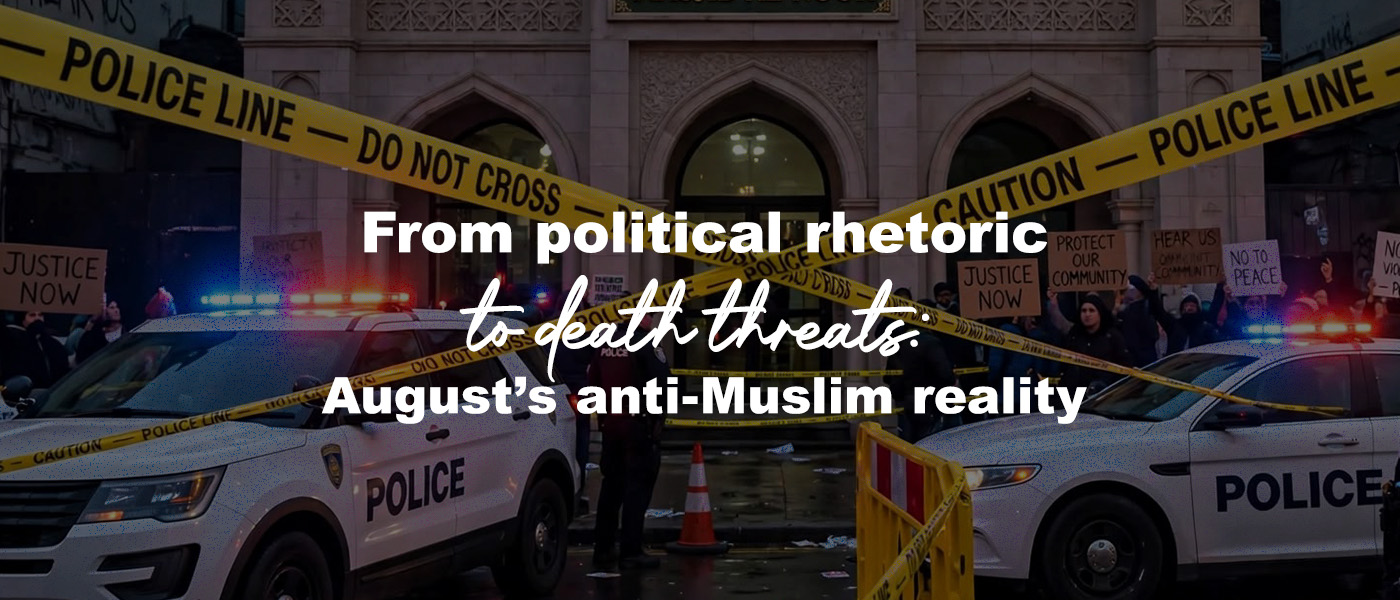
Within the U.S., the month of August brought a relentless stream of anti-Muslim incidents across the United States, with Muslims targeted in public, online, at work, in their communities and around places of worship. The sheer number and range of cases made the month difficult to dismiss as a collection of isolated events. What stands out about August is not simply that these incidents happened, but how many different forms they took and how widely they were spread. There was no single city, setting or type of victim. Muslims were targeted because of how they dressed, where they prayed, what they said, or simply because someone identified them as Muslim. Mosques and Islamic institutions were drawn into the same climate of hostility, while anti-Musim rhetoric online continued to blur the lines between hateful speech and real-world intimidation.
Read separately, each case can be reduced to a local crime report, a police statement or a few days of outrage. Read together, they are harder to dismiss. They show how quickly Islamophobia can move from words to threats, from threats to harassment, and from harassment to violence. They also show how normalized anti-Muslim hostility can become when every incident is treated as an exception rather than part of something larger. August offers only one month of evidence, but it was more than enough to show the scale of the problem. The incidents documented below are different in circumstance and severity, but together they point to the same reality that anti-Muslim hate in the United States is not confined to isolated headlines. It is appearing across communities, in different forms, with consequences that are becoming increasingly difficult to ignore.
Cincinnati: Cincinnati Islamic Center broken into for third time in seven years
The Westwood Islamic Community Center in Cincinnati was broken into early on August 3, marking the third break-in at the mosque in seven years. According to center leaders, those responsible cut through a wire barrier, smashed a window and entered an office, leaving the space in disarray. A surveillance camera and television monitors were stolen, the word “die” was written on a whiteboard, and glass was smashed on two posters displaying verses from The Quran. Muslim community leaders described the incident as a hate crime, although no suspects had been arrested at the time of the report. The break-ins have renewed concerns about security at Muslim houses of worship in Cincinnati, with community members now seeking support to improve protections at the center and other local mosques. Tala Ali, a community organizer, said she did not intend to ask the FBI to investigate the break-in as a hate crime, citing a lack of trust in federal authorities.
Texas: Anti-Muslim rhetoric intensifies around McKinney Mosque debate
The controversy surrounding the proposed mosque in McKinney also exposed how deeply anti-Muslim rhetoric has become intertwined with Texas politics. More than 150 people addressed the City Council during the August meeting, with many speakers warning about the “spread of Islam,” invoking fears of Sharia law and arguing that immigrant communities should “adapt to our norms.” Former McKinney Mayor George Fuller was even called a “traitor” after speaking in support of the development. The Dallas Observer reported that the mosque proposal had already faced years of resistance despite the Islamic Association of McKinney spending two years redesigning the project and studying potential traffic and drainage impacts. The hostility also did not begin in August. In September 2025, a sign announcing the future mosque was vandalized with large crosses and the words “Jesus Christ.” Council member Justin Beller pushed back against the rhetoric at the August meeting, describing the anti-Sharia messaging as “election year fear-mongering” and accusing politicians of using fear and outrage to gain power.
South Carolina: Nancy Mace escalates anti-Muslim rhetoric in August
Rep. Nancy Mace intensified her anti-Muslim rhetoric on August 7, with a second post that went beyond her atack on Muslim officeholders. Writing on her official congressional X account, Mace invoked the September 11 attacks and claimed that New York City was being “overrun” by people who wanted to see the country burn, calling the situation an “invasion.” The post came later the same day as her widely criticized remarks about Muslims in public office and framed Muslims more broadly as a threat to the United States. Maceopedia, which archived the posts and linked to the originals, noted that the comments were part of a wider pattern of Muslim-focused messaging from the congresswoman.
Wisconsin: Wisconsin mayor faces backlash over anti-Muslim social media posts
New Berlin, Wisconsin Mayor Dave Ament faced calls to resign in August after a series of anti-Muslim posts on his Facebook page drew public scrutiny. Among the material he shared was a post calling for all mosques in America to be shut down and Islam to be banned, another declaring that anyone who voted for a Muslim candidate was a “traitor,” and a video portraying Muslims as a terrorist threat. Ament defended the posts as “informational” and said he had not intended to disparage the Muslim community, later announcing that they would step back from social media. His response did little to quiet criticism. The Interfaith Conference of Greater Milwaukee said the posts spread hateful rhetoric and created fear among those targeted, while the Council on American-Islamic Relations (CAIR) called on Ament to apologize, resign and take responsibility for sharing material that demonized Muslims. The New Berlin Common Council was scheduled to discuss the mayor’s posts on August 25.
Florida: Florida teen arrested after alleged plot to carry out mosque shooting
A 19-year-old man from Venice, Florida, was arrested on August 7, after investigators said he discussed plans online to carry out a mass shooting at a mosque. According to a probable cause affidavit cited by WWSB, Giovanni Pimienta allegedly talked about obtaining an AR-15 and “shooting up a mosque,” while communicating with another person about possible mass shootings. Investigators also said he had produced a 61-page manifesto promoting white supremacist, antisemetic, anti-Black and anti-Muslim views, and had created an AI-generated video depicting himself and an associate in front of a mosque in South Carolina. Authorities received multiple tips warning that Pimienta might be preparing to carry out an attack, and he was taken into custody as part of an investigation involving the Florida Department of Law Enforcement and the FBI’s Joint Terrorism Task Force. He was charged with written threats to kill, threats to bomb or conduct a mass shooting, and unlawful use of a two-way communication device to commit a felony.
National: Trump’s social media post comparing Muslim family to his own draws CAIR condemnation
CAIR condemned President Donald Trump on August 9, after he shared a Truth Social post contrasting a formal photo of himself and First Lady Melania Trump with an image of Michigan Senate candidate Abdul El-Sayed and his wife, who wears hijab, beneath the caption, “Two VERY DIFFERENT America’s.” CAIR National Executive Director Nihad Awad said the post suggested that Muslim Americans were somehow less American because of their race or religion, arguing that “America does not belong to any one race or religion.” The organization called on Trump to remove the post and urged members of Congress to reject rhetoric that fuels anti-Muslim hostility and division. CAIR also pointed to Republican Sen. Bill Cassidy’s public condemnation of anti-Muslim remarks by members of his own party as an example of political leaders pushing back against the broader rhetoric.
National: Trump says ‘jihadists’ are being elected across the country
President Donald Trump used explicitly inflammatory language about political candidates during an August 10 Oval Office question-and-answer session, telling reporters that “jihadists” were being elected “all over the place.” While discussing the midterm elections, Trump grouped Democrats together with “communism” and “jihadism,” and said a friend had encouraged him to use the word “jihadists” because, in his view, “that’s what’s happening.” He went on to describe Democratic candidates as radical and dangerous, using the remarks to portray his political opponents as an ideological threat to the country. The comments added another example of Muslim-associated language being used as a political attack during the month, particularly through the loaded term “jihadist,” which is often used in public discourse to suggest extremism or terrorism.
Kentucky: Muslim hospital worker spat on and threatened in Lexington, Kentucky
A Muslim woman who works at the University of Kentucky hospital was allegedly spat on, harassed and threatened while walking to her car after work on August 11. Hoda A. Shalash, who was wearing a hijab, said a man spat in her face and told her, “that’s how I feel about people like you,” before threatening to kill her. Lexington and University of Kentucky police described the case as a reported hate crime. Authorities later identified the suspect as 52-year-old Damian Hisle, who was arrested on August 22, on charges related to terroristic threatening and harassment. According to an arrest affidavit, an investigator said the attack appeared to have been carried out for no reason other than to intimidate Shalash, who told police she feared for her life. Hisle was being held on a $5,000 bond at the time of the report.
Pennsylvania: Local Pennsylvania Muslim community targeted with threats after religious procession video spreads online
Muslims in Erie, Pennsylvania, faced reported threats in August after a video of a local Muslim religious procession circulated on social media and drew hateful reactions. The threats prompted a response from city officials, who worked with community members and law enforcement to address safety concerns. CAIR-Pennsylvania welcomed the city’s intervention on August 12, while urging authorities to investigate any credible threats and remain vigilant against further intimidation. CAIR-Pittsburgh Executive Director Christine Mohamed said threats aimed at a religious community should never be normalized or dismissed, and called on elected officials and community leaders to make clear that anti-Muslim bigotry has no place in Erie.
Oklahoma: Oklahoma governor orders terrorism review of CAIR and Muslim brotherhood
Oklahoma Gov. Kevin Stitt issued an executive order on August 12, directing state public-safety and homeland-security officials to investigate whether the Council on American-Islamic Relations (CAIR), the Muslim Brotherhood, or people and organizations acting on their behalf pose a terrorism or public-safety threat in the state. The order instructs the Oklahoma Office of Homeland Security to carry out an intelligence-based assessment and take any lawful preventive or investigative action supported by its findings. Stitt also directed state officials to advocate for federal designation of both CAIR and the Muslim Brotherhood as Foreign Terrorist Organizations, arguing that Oklahoma should not ignore organizations or networks that may support terrorism. The announcement itself did not establish that CAIR had committed terrorism or presented a proven security threat; rather, it launched a state review to examine those allegations.
New York: Anti-Muslim graffiti found at Long Island mosque construction site
Suffolk County police launched a hate-crime investigation in August after anti-Muslim graffiti was discovered at the construction site of the Islamic Center of Mastic-Shirley in Shirley, Long Island. According to ABC7 New York, hateful comments about Islam were written on a banner at the site and reported to police on the afternoon of August 15. The case was referred to the Suffolk County Police Hate Crimes Unit, which continued investigating the vandalism. No arrests had been made at the time of the report.
California: Irvine mosque targeted by online threats after false claims spread on social media
The Islamic Center of Irvine in California was targeted by violent online threats in August after false claims about the mosque spread across social media. According to CAIR-LA, anti-Muslim accounts falsely alleged that the center had “seized control” of three nearby buildings it had purchased and was attempting to create a “parallel society” where U.S. laws would not apply. The claims triggered a surge of hateful rhetoric and threats directed at the mosque and its congregants. The Islamic Center of Irvine contacted local law enforcement over the threats, while CAIR-LA condemned the campaign as dangerous misinformation that placed the community’s safety at risk.
Texas: Texas candidate withdraws after anti-Muslim remark during GOP interview
A candidate seeking the Republican nomination for justice of the peace in Young county, Texas, withdrew from consideration after an anti-Muslim remark was made during his August 18, interview with the county Republican committee. Joshua Gallardo, a former K-9 handler with the Young County Sheriff’s Office, said a precinct chair asked whether his police dog could be trained to attack Muslims. Young County Republican Party Chairman Lange Burgess confirmed that the remark was made, describing it as a mistake but declining to identify the committee member responsible. Gallardo said the comment shocked him and conflicted with his belief that people should be treated equally regardless of their religion or background. He subsequently withdrew from the Republican nomination process and announced plans to run as a write-in candidate, saying he wanted greater transparency about how candidates were being selected. Burgess disputed Gallardo’s characterization of the episode and accused him of publicizing it to gain sympathy from voters. Gallardo, for his part, said he did not believe the remark represented the Republican Party or its candidates as a whole.
Michigan: Anti-Islam ‘Crusader’ march targets Muslim-majority Dearborn
An anti-Islam demonstration billed as the “Dearborn Crusade-March on Islam” was organized in Dearborn, Michigan, on August 18, with promotional material using explicitly hostile language about Muslims and portraying Islam as a threat to the United States. The event listing, published by a group calling itself Americans Against Islamification, declared that organizers would “not surrender to Islam,” described Dearborn as “ground zero,” warned of supposed “demographic replacement,” and promoted the slogan “Crusade or be replaced.” The planned demonstration prompted Dearborn officials to increase security and relocate the City Council meeting, while police urged residents not involved in city business to avoid the area. The protest ultimately drew competing groups, with hundreds gathering outside the meeting and police in riot gear working to separate demonstrators as confrontations broke out.
Maryland: Muslim women harassed and told to remove hijabs at Maryland market
Several Muslim women wearing hijab were reportedly harassed at a market in Montgomery County, Maryland, in August after a man followed them into the store and confronted them near the checkout area. According to CAIR-Maryland, video provided by a witness showed the man repeatedly demanding that the women remove their headscarves while making derogatory comments about Islam. When the witness began recording out of concern that the encounter could become physical, the man allegedly turned his hostility toward that person as well, making offensive remarks about the Prophet Muhammad (SAW) and The Quran, declaring that America was “his country,” and claiming that his behavior was protected by freedom of speech. A store manager intervened and told the man to shop peacefully or leave, and the police were called, but he reportedly drove away before officers arrived. CAIR-Maryland praised the witness for stepping in and urged anyone with additional information or video of the incident to contact Montgomery County police.
Texas: Texas governor seeks federal investigation into Muslim ablution stations at airports
Texas Gov. Greg Abbott asked the U.S. Justice Department on August 21, to investigate ablution stations at George Bush Intercontinental Airport in Houston and Dallas-Fort Worth International Airport, arguing that facilities intended to accommodate Muslim travelers performing wudhu, the ritual washing before prayer, amount to religious discrimination. Abbott said the stations provide special treatment based on religion and asked federal authorities to determine whether the airports were violating anti-discrimination requirements attached to federal funding. The facilities have existed for years, and Muslim leaders and religious-liberty experts disputed Abbott’s characterization, noting that they are not restricted to Muslim travelers. Abbott had previously asked the Department of Transportation to investigate the airports and threatened to review state grants connected to them. Shortly afterward, DFW abandoned plans for additional washing stations. University of Texas law professor Steven Collis told The Washington Post that he viewed the controversy as part of a broader pattern of state officials targeting Muslims rather than a genuine case of preferential treatment.
California: Anti-Islam rally outside Los Angeles mosque draws one supporter, and a ton of backlash
A planned anti-Islam rally outside the Islamic Center of Southern California in Los Angeles on August 23, drew only one supporter alongside organizer Eoin Richard, despite promotional material calling on “free speech advocates and Christian leaders” to march against what Richard described as “Jihadist sympathizers.” Around 30 community members and counter-protesters gathered at the mosque in response, standing near the entrances as worshippers arrived for prayer. Richard later moved the demonstration to nearby Precious Blood Catholic Church, saying he had received threats. Confrontations followed after Richard and fellow activist Jairo Tomico entered the church despite being asked to leave, and the pair were eventually forced outside. Ricchard later fled into a nearby Starbucks after being pepper-sprayed by counter-protesters, where employees also repeatedly asked him and Tomico to leave. The rally had been publicly supported online by Jake Lang, who was organizing a broader series of anti-Islam demonstrations around the country at the time.
California: Temecula mosque receives letter threatening mass killing of Muslims
The Islamic Center of Temecula Valley in California reported receiving a letter on August 26, that threatened the mass killing of Muslims. According to the U.S. Department of Justice, the letter included the statement, “I CANNOT WAIT FOR THE DAY TO KILL EVERY ONE OF YOU,” along with a drawing of crosshairs over a bearded figure and an obscenity directed at Allah (SWT). Investigators traced the letter to 60-year-old Louis White of Warner Springs, and during a search of his residence on August 29, authorities said they seized several firearms, including what appeared to be an unserialized AR-15-style short-barreled rifle. White was later federally charged with mailing threatening communications and remained in state custody at the time the charge was announced. The Department of Justice noted that the charge is an allegation and that White is presumed innocent unless proven guilty in court.
California: Jewish American Summit draws criticism over anti-Muslim remarks
A Jewish American Summit held in Los Angeles at the end of August came under criticism after speaker Mosab Hassan Yousef, a Palestinian ex-militant and former Muslim, delivered a series of hostile remarks about Islam and Muslims. During his appearance, Yousef said he did not want Muslims in America, told Muslims that the country would be better without their beliefs, and said they “disgust” him, drawing applause from parts of the audience. In a September 5 Los Angeles Times opinion piece, UCLA professor David N. Myers and Muslim Public Affairs Council President Salam Al-Marayati argued that the summit’s organizers and sponsors bore responsibility for giving Yousef a platform and urged them to condemn his remarks unequivocally. The two writers said the episode illustrated how openly anti-Muslim rhetoric can become normalized in public life and called for Jewish, Muslim, Christian and other communities to confront both Islamophobia and antisemitism together.
How do we make Islam harder to misrepresent?
When anti-Muslim rhetoric is being repeated by public figures, amplified online, and followed by threats, harassment, vandalism and violence, simply condemning Islamophobia is not enough. There also has to be a serious effort to confront the ignorance and misinformation that allow it to spread. That is where Quran distribution, interfaith dialogue and Islamic education become especially important.
Across our U.S. divisions, this work gives people the opportunity to encounter Islam directly rather than through fear-driven headlines, political rhetoric or social media distortions. Quran distribution places the words of The Quran into the hands of people who may never have read it for themselves. Islamic education gives people a chance to ask questions, challenge assumptions and learn what Muslims actually believe. Interfaith dialogue creates something even harder to dismiss—direct human contact between people who might otherwise only know one another through stereotypes. That work matters because Islamophobia depends heavily on distance. It is easier to fear a community you have never met, easier to believe falsehoods about a faith you have never studied, and easier to dehumanize people whose voices you have never heard.
Every Quran distributed, every open house, every educational program and every interfaith conversation creates an opportunity to break that cycle. None of this means education alone can stop hatred. Some people will hold on to prejudice no matter how much information is placed in front of them, but many others have simply never been given the chance to learn about Islam from Muslims themselves. In a moment when Muslims in the United States are being spoken about, targeted and politicized with alarming frequency, that opportunity matters enormously. Our divisions are not only responding to misinformation after it spreads. They are building relationships, creating understanding and making sure Islam is represented by its own teachings and by the people who live them every day.
That is not peripheral work. It is part of the response.
Dua
O Allah! Protect our communities from hatred, prejudice, and harm. Give strength and patience to those who are targeted because of their faith, and bring comfort to those who have been hurt.
Soften the hearts of those who carry hatred, replace ignorance with understanding, and guide us to respond with wisdom, courage, and dignity. Help us speak the truth with compassion, stand firmly against injustice, and be a source of peace in our communities.
O Allah! Make our mosques, homes, and neighborhoods places of safety. Bring people together through knowledge and sincere conversation, and do not allow fear or hatred to divide us. Grant justice to those who have been wronged, guidance to those who are lost, and protection to all who are vulnerable.
Ameen, ya Rabb!