
Why are young Muslims abandoning religious spaces?
September 24, 2026
Across many Muslim communities, there is a growing concern that is becoming increasingly difficult to ignore—young Muslims are becoming more distant from religious spaces. Some still believe in Allah (SWT), still identify strongly as Muslim, still fast in Ramadan, make dua, and feel love for the Prophet (SAW), yet they rarely attend the mosque or participate in community programs. Others remain connected to Islam in a more private way, turning instead to online lectures, podcasts, social media, books, or small circles of friends for religious guidance and spiritual support. For some, the distance becomes much deeper, eventually leading to serious doubts about faith, religious authority, or even Islam itself. It is easy to look at this reality and blame outside influences such as social media, secular culture, university life, peer pressure, or the moral confusion of modern society.
Certainly, these influences can play a role, and it would be unrealistic to deny the pressures that young Muslims face today. However, if we reduce the issue to outside forces alone, we may miss a much more uncomfortable truth. Sometimes the problem is not simply that young Muslims are being pulled away from Islam, but that the religious spaces meant to bring them closer to Allah (SWT) are not always meeting them with the intellect, compassion, depth, and understanding they need. This is where the conversation must become more honest. A young Muslim may walk into a mosque carrying questions about purpose, identity, relationships, faith, suffering, sexuality, mental health, family expectations, or the existence of Allah (SWT), only to leave feeling that there was no safe place to speak openly about any of it. Others may grow up hearing Islam presented mainly through rules, warnings, and prohibitions, yet rarely encounter the beauty of tawbah, the mercy of Allah (SWT), the wisdom behind worship, or the character of the Prophet (SAW). Some may experience religious spaces as culturally rigid, socially exclusive, or disconnected from the realities of their lives. Others may become disillusioned when they witness hypocrisy, harshness, racism, favoritism, poor leadership, or a lack of accountability from those who speak most loudly about Islamic values.
None of this means that Islam itself is the problem. Islam should never be judged solely by the shortcomings of Muslims, just as the truth of revelation does not change because people sometimes fail to embody it. However, Muslim communities must also resist the temptation to use that principle as a shield against self-examination. If young people repeatedly experience religious environments as places where they feel unheard, judged, dismissed, or invisible, then we have to take seriously the possibility that some of the distance we are witnessing is not simply rebellion against religion, but a response to the way religion is being represented and lived around them.
In The Quran, Allah (SWT) says to the Prophet (SAW), “It is out of Allah’s mercy that you O Prophet have been lenient with them. Had you been cruel or hard-hearted, they would have certainly abandoned you. So pardon them, ask Allah’s forgiveness for them, and consult with them in conducting matters. Once you make a decision, put your trust in Allah. Surely Allah loves those who trust in Him.” (The Clear Quran®, 3:159)
The Prophet (SAW) did not compromise revelation in order to keep people close, but he also did not treat harshness as a sign of religious seriousness. His way combined truth with gentleness, correction with compassion, firmness with patience, and guidance with genuine care for the person being guided. That balance is essential for Muslim communities today. Young Muslims do not need a watered-down Islam that avoids difficult teachings, but neither do they need religious environments that make them feel that struggling, questioning, or making mistakes places them beyond the reach of mercy. They need spaces where Islam is taught with confidence and depth, but also where people are treated with dignity, where questions can be asked without humiliation, and where spiritual growth is understood as a journey rather than a performance.
In this article, we will explore some of the deeper reasons young Muslims are becoming disconnected from religious spaces, including questions of belonging, leadership, culture, intellectual doubt, and the way Islam is communicated to a new generation. We will also consider what The Quran and Sunnah teach us about creating communities that are spiritually grounded, compassionate, intellectually honest, and capable of helping young Muslims remain connected to Allah (SWT) and their deen.
A mosque full of people, yet empty of connection
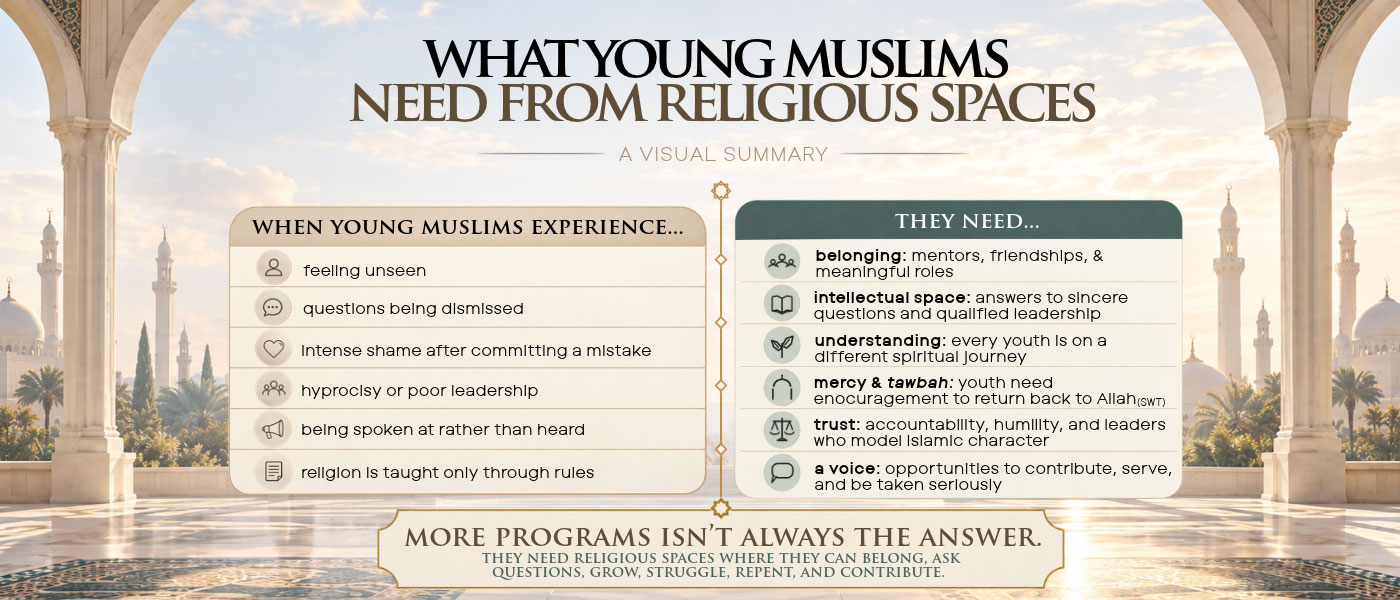
One of the most overlooked reasons young Muslims drift away from religious spaces is that many never develop a genuine sense of belonging within them. A mosque can be full every Friday and still feel socially empty to the young person sitting quietly in the back. Attendance alone does not create community. Belonging develops when people are known, welcomed, trusted, and given meaningful relationships with others. Yet in many religious spaces, young Muslims may grow up attending prayers, Quran classes, and occasional programs without forming a real connection with an imam, mentor, teacher, or older member of the community.
They may know the building very well while hardly knowing the people inside it. Over time, the mosque can begin to feel less like a spiritual home and more like a place they are expected to visit. This becomes especially significant during adolescence and early adulthood, when questions of identity, friendship, purpose, and acceptance become increasingly important. If a young Muslim finds deeper friendship, encouragement, and understanding everywhere except the religious community, it is not difficult to see which spaces will eventually occupy more of their time and emotional energy.
The prophetic model of community was far more relational. The Prophet Muhammad (SAW) did not treat people as anonymous members of a crowd. He knew his companions, noticed their circumstances, taught them according to their needs, gave them responsibilities, visited the sick, comforted the grieving, encouraged the young, and created bonds of brotherhood that extended beyond formal acts of worship. Even younger companions were not treated as irrelevant simply because of their age.
Ibn ‘Abbas (ra) was still young when the Prophet (SAW) gave him profound personal advice, telling him, “Be mindful of Allah and Allah will protect you” (at-Tirmidhi). The significance of moments like this is easy to overlook. The Prophet (SAW) was not only transmitting information, he was investing personally in a young believer and helping shape his understanding of Allah (SWT), reliance, and faith. Young Muslims today also need relationships in which they are not merely spoken at, but personally guided, encouraged, and taken seriously.
This is why the question of belonging cannot be solved simply by adding more youth events to the calendar. Programs may bring young Muslims into the building, but relationships are what make them feel that they are part of something. A basketball tournament, conference, or lecture can be beneficial, but these activities cannot replace mentorship, friendship, and meaningful participation in the life of the community. Young people need to feel that their presence matters beyond attendance numbers. They need opportunities to serve, organize, teach what they know, contribute ideas, and gradually take responsibility. When they are constantly described as “the future of the Ummah” but are given little role in its present, the message can begin to feel hollow. A community that wants young Muslims to remain connected must therefore do more than create programs for them, it must create a place for them. The difference between those two approaches is enormous.
The cost of silencing difficult questions
Young Muslims today are exposed to questions about religion much earlier and much more intensely than previous generations. By their teenage years, many have already encountered arguments about the existence of God, the reliability of revelation, evolution, morality, gender, sexuality, suffering, free will, the preservation of The Quran, the authenticity of hadith, and the place of religion in a modern society. These questions are not necessarily signs of weak faith. In many cases, they are the natural result of trying to understand what one believes and why. The greater problem begins when a young Muslim discovers that there is nowhere in their religious environment to explore these questions seriously. If every difficult question is met with suspicion, a quick answer, or an instruction to simply “have more faith,” curiosity can slowly turn into frustration. A person may begin to assume that Islam has no satisfying response, when in reality they may simply never have been given access to the intellectual tradition capable of addressing what they are asking.
Allah (SWT) says in The Quran, “Have they not reflected upon their own being? Allah only created the heavens and the earth and everything in between for a purpose and an appointed term. Yet most people are truly in denial of the meeting with their Lord!” (The Clear Quran®, 30:8) Elsewhere, He challenges humanity to contemplate the heavens, the earth, history, creation, and even their own existence. Prophet Ibrahim (as) famously asked Allah (SWT) to show him how He (SWT) gives life to the dead. Allah (SWT) asked him, “‘Do you not believe?” Ibrahim replied, ‘Yes I do, but just so my heart can be reassured.’” (The Clear Quran®, 2:260)
There is an important lesson here for religious educators, actually: a question can emerge from disbelief, but it can also emerge from a sincere desire for stronger conviction. Wisdom lies in knowing the difference. Many young Muslims also inherit conclusions without being taught the reasoning behind them. They may know that Islam teaches a particular belief or moral boundary, but not understand the worldview that gives that teaching meaning. When such a person later encounters a sophisticated objection, they can feel intellectually unprepared. Simply repeating the ruling more loudly does not solve that problem. Religious education has to move beyond telling young Muslims only what Islam teaches and begin helping them understand how Islamic knowledge is constructed, why Muslims trust The Quran, how the Sunnah was preserved, how scholars reason, why legitimate disagreement exists, and how Islamic moral reasoning differs from the assumptions of contemporary culture.
A faith that is inherited but never examined may remain stable for a time, but when it is challenged, a person needs more than familiarity. They need intellectual foundations. This is also where humility becomes essential. No imam, parent, teacher, or youth leader will have an immediate answer to every question, and pretending otherwise can do more harm than admitting uncertainty. There is nothing shameful about saying, “I do not know, but let us find someone qualified who does.” Islamic scholarship has always recognized the limits of individual knowledge. What young Muslims need is not the illusion that religious leaders possess instant answers to everything, but confidence that their questions will be taken seriously and directed toward trustworthy sources of knowledge. A community that can respond to difficult questions with patience, scholarship, and humility teaches young Muslims something deeper than any single answer: it teaches them that Islam is not afraid of sincere inquiry.
Why is there a disconnect between the values of Islam and how our communities behave?
Young Muslims are often told to take Islam seriously, respect religious authority, uphold good character, and live by a clear moral standard. However, those lessons become much harder to absorb when the people delivering them appear unwilling to hold themselves to the same expectations. A young person may hear repeated sermons about honesty, justice, humility, and accountability, yet witness favoritism, arrogance, gossip, financial disputes, family politics, or the protection of influential individuals within the same community. They may see certain people publicly criticized for minor mistakes while others are quietly excused because they are respected donors, prominent families, or well-known leaders.
Over time, the issue is no longer simply that imperfect people exist in religious spaces. Young Muslims understand that Muslims are human and capable of failure. The deeper problem arises when communities demand accountability from the young while resisting accountability for themselves. When religious authority begins to look selective, moral instruction can start to lose its credibility. Islam does not ask Muslims to present themselves as flawless. In fact, The Quran strongly condemns the contradiction between telling others to do good while neglecting one’s own conduct.
Allah (SWT) says in The Quran, “Do you preach righteousness and fail to practice it yourselves, although you read the Scripture? Do you not understand?” (The Clear Quran®, 2:44) In another chapter, Allah (SWT) says, “O believers! Why do you say what you do not do? How despicable it is in the sight of Allah that you say what you do not do!” (The Clear Quran®, 61:2-3)
Words carry weight when they are supported by character. Advice becomes meaningful when the person giving it demonstrates sincerity, humility, and a willingness to correct their own mistakes. The Prophet Muhammad (SAW) embodied this consistency to an extraordinary degree. His authority did not rest only on what he taught, but on the fact that his companions witnessed his patience, justice, generosity, courage, and mercy in everyday life. He did not call people toward a standard from which he considered himself exempt. This becomes especially important in an age when young Muslims are highly attentive to contradictions between public image and private behavior. They are surrounded by constant access to information and can easily see when a community’s public messaging does not match its internal culture. If leaders speak about justice but refuse transparency, preach humility but demand unquestioning deference, or condemn moral failures in public while quietly ignoring serious problems within their own institutions, young people notice.
Some may begin by questioning the credibility of the leader, but if that leader has been presented as the face of Islam, the disappointment can gradually affect their perception of religion itself. That confusion is unfair to Islam, because the failures of Muslims do not diminish the truth of revelation. Yet communities should also recognize their responsibility in creating that association. When religious authority is exercised carelessly, hypocrisy does not remain a private moral failure, it can become a barrier between people and the deen. The answer is not to expect religious leaders, parents, or community members to become perfect. That would be unrealistic and contrary to the Islamic understanding of human nature. What young Muslims need to see is something more attainable and, in many ways, more powerful—honesty. They need leaders who can admit mistakes, apologize when necessary, accept criticism without defensiveness, and apply the same standards to themselves that they expect from others. They need communities where accountability is not treated as disrespect and where protecting an institution’s reputation does not become more important than protecting justice.
A leader who says, “I was wrong,” may actually strengthen trust rather than weaken it, because sincerity is more convincing than the performance of perfection. When Muslim communities live closer to the values they preach, religious authority becomes more believable, advice carries greater weight, and young Muslims are better able to see the difference between Islam itself and the shortcomings of the people who represent it.
Islam is a religion of peace, love, and encouragement, not shame and guilt
For some young Muslims, religion is introduced less as a path of spiritual growth and more as a constant measurement of failure. They learn very quickly which behaviors are considered sinful, what they should avoid, and what a “good Muslim” is supposed to look like, but they may hear far less about what to do when they fall short. Mistakes can become sources of embarrassment rather than opportunities for repentance, and personal struggles may be hidden out of fear that admitting them will lead to judgment. In this environment, religious life can become performative. A young person learns how to appear observant in front of family or community while quietly carrying struggles they believe they cannot reveal. The problem is not that Islam should stop speaking clearly about sin. Moral responsibility is an essential part of the deen. The problem arises when young Muslims are taught extensively about wrongdoing but inadequately about tawbah, forgiveness, gradual growth, and the mercy of Allah (SWT).
If the only religious message someone internalizes is that failure makes them shameful, then eventually hiding from religious spaces can feel easier than confronting the fear of being exposed within them. The Quran presents a very different relationship between sin and the believer’s return to Allah (SWT). Allah (SWT) addresses people who have wronged themselves and says,
“Say, O Prophet, that Allah says, ‘O My servants who have exceeded the limits against their souls! Do not lose hope in Allah’s mercy, for Allah certainly forgives all sins. He is indeed the All-Forgiving, Most Merciful.’” (The Clear Quran®, 39:53)
Islam does not teach that a believer must become spiritually flawless before turning back to Allah (SWT). Turning back to Allah (SWT) is precisely what the believer does because they are not flawless. The Prophet (SAW) reinforced this understanding by teaching that Allah (SWT) is more pleased with the repentance of His servant than a person who unexpectedly recovers something precious they believed was permanently lost (Sahih Muslim). Repentance, then, is not a humiliating exception reserved for those who have failed at religion. It is part of the normal spiritual life of the believer. When Muslim communities fail to communicate this, young people can begin to think that their struggles disqualify them from religious life rather than becoming one of the very reasons they should remain close to Allah (SWT).
Shame also becomes dangerous when communities are more concerned with appearances than transformation. A young Muslim may be struggling with a private sin, an unhealthy relationship, addiction, missed prayers, or some other behavior they know is wrong, but the fear of damaging their reputation can prevent them from seeking help. In such circumstances, preserving the image of being a “good Muslim” becomes more important than actually becoming a healthier Muslim. This creates a culture in which people learn concealment but not necessarily recovery. Islam, by contrast, does not require believers to publicly expose their sins in order to prove sincerity. It encourages repentance, reform, and discretion while directing the believer back toward Allah (SWT). Religious communities therefore need to become places where people can seek guidance without believing that a single confession of weakness will permanently define them. A person should be able to say, “I am struggling,” without immediately becoming known only by the thing they are struggling with.
Young Muslims also need to encounter a more complete understanding of spiritual development. Iman rises and falls. Habits take time to build. Temptation does not disappear simply because someone knows an Islamic ruling, and knowledge does not automatically produce perfect behavior. Religious education becomes far more realistic when it teaches young people how to recover after failure, how to make sincere tawbah, rebuild salah after neglecting it, distance themselves from harmful habits, seek trustworthy help, make amends when they have harmed others, and continue moving toward Allah (SWT) without surrendering to despair. The goal is not to make sin feel insignificant, it is to make the mercy of Allah (SWT) feel greater than the believer’s hopelessness. A religious space that understands this will not simply tell young Muslims what they must avoid. It will teach them what to do when they stumble, how to stand again, and why the door back to Allah (SWT) remains open.
Opening the doors: What can our masajid do to support the youth?
Allah (SWT) tells the Prophet (SAW) that had he been harsh and hard-hearted, people would have dispersed from around him, and in the same verse He commands him to pardon, seek forgiveness for others, and consult them in communal matters (The Clear Quran®, 3:159). That combination of mercy, forgiveness, and consultation offers an important model for Muslim institutions today. Welcoming young people does not require changing Islam. It requires reflecting Islam more fully in the way our communities teach, lead, listen, and care.
Masajid can begin by making several intentional changes:
- Build relationships before building programs: Young Muslims need mentors, teachers, imams, and older community members who know them personally. A successful youth program should not only be measured by how many people attended an event, but by how many meaningful relationships were formed because of it.
- Give young people real responsibility: Youth should not constantly hear that they are “the future of the Ummah” while having little influence in the present. Masajid can involve them in committees, community service, event planning, media, educational initiatives, outreach, and other meaningful areas of leadership while providing appropriate guidance and mentorship.
- Create spaces for difficult questions: Masajid should regularly provide opportunities where young Muslims can ask honest questions about faith, morality, relationships, science, identity, doubts, and contemporary life without being embarrassed or immediately judged. When an answer requires greater expertise, leaders should be comfortable referring them to qualified scholars rather than pretending to know everything.
- Make imams and teachers more approachable: A khutbah once a week cannot replace personal guidance. Where possible, religious leaders should have regular office hours, discussion circles, mentorship sessions, or informal gatherings where younger Muslims can speak with them outside a formal lecture environment.
- Address the realities young Muslims actually face: Khutbahs and educational programs should engage thoughtfully with issues such as relationships, loneliness, pornography, career pressure, marriage, social media, substance use, Islamophobia, identity, family conflict, and the challenge of maintaining faith in a secular environment. Avoiding difficult subjects does not make those issues disappear, it only encourages young Muslims to search elsewhere for guidance.
- Make the masjid socially alive: Religious learning is essential, but community is also built through meals, sports, service projects, study circles, retreats, family events, and simple opportunities to spend time together. The masjid should offer young Muslims halal spaces to build friendships rather than assuming that spiritual connection develops only through formal lectures.
The Prophet (SAW) showed that people are drawn not only to truth, but to truth embodied with mercy, wisdom, patience, and beautiful character. If our masajid can become places where young Muslims encounter those qualities consistently, then the question may gradually shift from why young people are leaving religious spaces to why they would want to leave a community in which they are known, valued, guided, and continually reminded of Allah (SWT).
Dua
May Allah (SWT) guide our young people, strengthen their iman, protect their hearts from doubt and despair, and make them among those who find peace, purpose, and belonging in His remembrance.
May He grant our parents, teachers, imams, and community leaders wisdom, patience, humility, and mercy in the way they nurture the next generation.
May Allah (SWT) make our masajid places of knowledge, compassion, sincerity, repentance, and genuine community, and may He allow every young Muslim who feels distant, uncertain, or forgotten to find a path back to Him.
Ameen, ya Rabb!