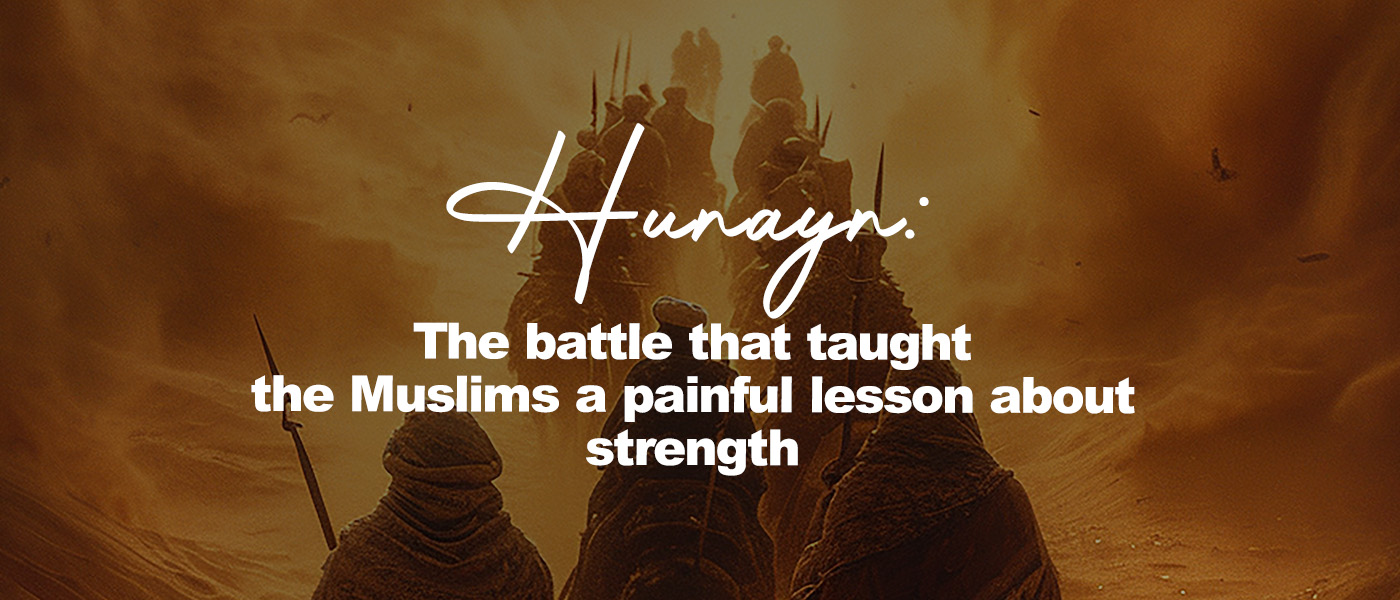
Some of the hardest lessons in faith do not come in moments of weakness, but in moments when strength appears obvious. By the eighth year after Hijrah, the Muslim community stood at a point that would have seemed unimaginable only a year earlier. Makkah, the city from which the Prophet Muhammad (SAW) and his companions had once been driven, had now opened before them. The idols around the Ka’bah had fallen, old enemies had lowered their resistance, and Islam had entered the heart of Arabia with a force that could no longer be ignored. Outwardly, it was a moment of triumph where years of patience, persecution, migration, and struggle had led to a victory that changed the political and spiritual landscape of the region. However, history often shows that major victories are followed by tests no less serious than the struggle that came before them.
The opening of Makkah did not end confrontation, it created a new reality that nearby tribes immediately understood. For some, the rise of Islam now seemed unstoppable unless action was taken quickly. Among those watching closely were the tribes of Hawazin and Thaqif, who saw in the Prophet’s (SAW) growing influence a direct challenge to their own standing in Arabia. Their response was immediate. Before the Muslims could fully settle after Makkah, preparations for another battle had already begun. This time, however, the Muslims marched under very different conditions from earlier campaigns. Their numbers were larger than ever before, approximately 12,000 – far more than Badr, more than Uhud, and more than any previous battlefield in the Prophet’s (SAW) life. For the first time, the Muslim army outwardly appeared overwhelming.
It is here that one of the deepest lessons of Hunayn begins, because strength itself can become a test when hearts begin to notice it independent of the One who granted it. The Quran later described that day as a moment when the large number of believers, though impressive, brought no benefit when the battle suddenly changed.
Allah (SWT) said in The Quran, “Indeed Allah has given you ˹believers˺ victory on many battlefields, even at the Battle of Hunayn when you took pride in your great numbers, but they proved of no advantage to you. The earth, despite its vastness, seemed to close in on you, then you turned back in retreat.” (The Clear Quran®, 9:25)
The Battle of Hunayn, therefore, was not simply a military encounter. It became a lesson in reliance, humility, leadership under pressure, and the way Allah (SWT) teaches a community that victory remains His gift, not the product of numbers alone.
Why did the Battle of Hunayn happen?
The Conquest of Makkah changed Arabia almost overnight. For years, the Quraysh had stood as the strongest visible barrier against the spread of Islam, and many tribes had watched carefully, measuring their own positions according to whether Makkah remained resistant or eventually yielded. When the city entered under the authority of the Prophet Muhammad (SAW) with minimal bloodshed, that balance shifted immediately. Tribes that had once delayed decisive action now understood that the political landscape was changing faster than expected. Among the first to react were the tribes of Hawazin and Thaqif. Both possessed military strength, tribal alliances, and influence in the region’s east and southeast of Makkah, and both understood that if they waited too long, they might soon face the Muslims under less favorable conditions. Their leader, Malik ibn ‘Awf al-Nasri, chose not to remain defensive. Instead, he gathered a large force and prepared to confront the Muslims before the effects of Makkah’s opening spread further across Arabia.
Historical reports mention that Malik made an unusual decision before the battle. He ordered that families, wealth, and livestock accompany the army. His reasoning was that if people saw their households and possessions behind them, they would fight with greater determination and resist retreat. Some among the older tribal voices objected, warning that such a decision could turn defeat into a far greater loss, but Malik pressed ahead. The urgency of the moment had convinced him that hesitation would only strengthen the Muslims further.
News of these preparations reached the Prophet (SAW) quickly. The Muslim community had only just witnessed the opening of Makkah, yet another major confrontation was already forming. This time, however, the Muslims moved with a force unlike any they had assembled before – 10,000 who had come for the Conquest of Makkah, joined by 2,000 more from among the newly participating people of Makkah. Outwardly, it was the largest Muslim army yet seen. It was precisely under these outward conditions of strength that the Battle of Hunayn would begin teaching one of its deepest lessons.
Entering the valley of Hunayn
The Muslim army advanced toward Hunayn while it was still early, approaching the valley before sunrise. The terrain there was difficult because it had narrow passages, uneven ground, and elevated positions from which hidden movement could easily go unnoticed. For any army moving in large numbers, such terrain could quickly become dangerous if the enemy had already taken position. This is exactly what had happened. Malik ibn ‘Awf had arranged his forces carefully during the night, placing fighters in concealed positions along the valley’s sides and waiting until the Muslims entered fully before launching an attack. His aim was not to meet them in open formation, but to break their momentum before they could organize themselves.
As the Muslims descended into the valley at dawn, the ambush began suddenly. Arrows were released from hidden positions, followed by a rapid assault from multiple directions. The surprise was immediate and severe. Before the front ranks could fully settle into battle formation, confusion spread through parts of the army. Those who had fought beside the Prophet (SAW) in earlier battles understood quickly how rapidly the battle conditions could change, but among the army were also many who had only recently entered Islam and had little experience under battlefield pressure. The first moments of Hunayn, therefore, carried not only military shock, but the instability that comes when an army includes hearts tested in different ways.
While many around him began to scatter, the Prophet (SAW) did not move back. In one of the most striking moments of the battle, he (SAW) stayed mounted on his mule, refusing to withdraw even as confusion spread around him and enemy pressure intensified. Those who were closest to him later described how near he (SAW) was to the front during the most difficult moments. Al-Bara ibn ‘Azib said that when battle became severe, they would seek closeness to the Prophet (SAW) because he (SAW) was the one nearest to the enemy. This was not only courage, it was leadership that refused to disappear when people most needed firmness before their eyes. In those critical initial moments, the Prophet (SAW) made two distinct calls. He (SAW) turned right and said, “O the group of Ansar!” They said, “Labbaik, O Allah’s Messenger (SAW)! Rejoice, for we are with you!” Then he (SAW) turned left and said, “O the group of Ansar!” They said, “Labbaik! O Allah’s Messenger (SAW)! Rejoice, for we are with you!” After this, the Prophet (SAW) dismounted his mule and called out words that have remained among the most memorable declarations uttered on any battlefield, “I am Allah’s Slave and His Apostle.” (Sahih Bukhari) These words were spoken not in triumph, but in the midst of the confusion of those who stood with him, but had not yet returned. It was a declaration of certainty when the battlefield itself had become unstable.
He (SAW) then asked his uncle al-’Abbas, whose voice carried strongly, to call everyone back. His calls reached hearts before they reached formations. One by one, then in groups, companions began turning back. Those who had moved away under the force of surprise now returned toward the Prophet (SAW), answering the call with renewed resolve. The battlefield had not yet turned, but its center had been restored. Around the Prophet (SAW), what had nearly collapsed was beginning to gather again into strength.
The turning point of the battle
Once the companions began returning to the Prophet (SAW), the shape of the battle changed quickly. What had moments earlier looked like disorder now became renewed formation around a clear center. The Muhajirun and Ansar gathered again, and those whose hearts had steadied moved forward with determination rather than retreat. At that stage, the battle was no longer defined by surprise alone. The first shock had passed and discipline returned. The Prophet (SAW) directed the ranks while those around him pressed forward, and the hidden advantage that Hawazin had gained through ambush began to weaken once direct confrontation replaced sudden attack. It was during this turning point that The Quran describes divine help descending after fear, “Then Allah sent down His reassurance upon His Messenger and the believers, and sent down forces you could not see, and punished those who disbelieved. Such was the reward of the disbelievers.” (The Clear Quran®, 9:26)
The word sakinah here is especially important. Before outward victory came inward calm. The hearts that had felt constricted in the opening moments were now steadied by a reassurance that battle itself could not produce. Some narrations mention that the Prophet (SAW) took a handful of dust or pebbles and cast it toward the enemy while praying for their defeat. The companions then advanced with renewed strength, and the lines of Hawazin began to break. What had begun as a carefully planned ambush was now reversing under pressure they had not expected. The army of Hawazin retreated in different directions, some toward Awtas, others toward Ta’if, leaving behind large numbers of captives, livestock, and wealth. The same battlefield that had opened with sudden fear now closed in unmistakable victory.
Yet what remained most lasting about Hunayn was not the spoils that followed, nor even the military result itself. It was the lesson made clear by The Quran that numbers alone had offered no protection in the opening moments, and that calm returned only when reliance returned fully to Allah (SWT). Hunayn therefore became one of the clearest reminders that even after great victories, believers remain in need of humility before the next test arrives.
The Distribution of Spoils and a Renewed Lesson in Prophetic Wisdom
After the victory at Hunayn, the Muslims found themselves before an immense amount of spoils – thousands of animals, significant wealth, and many captives from the tribe of Hawazin. In sheer quantity, it was among the largest collections of war gains during the lifetime of the Prophet (SAW). Yet what drew immediate attention was not the size of the spoils, but the way the Prophet (SAW) chose to distribute them.
He (SAW) granted exceptionally generous portions to certain newly reconciled leaders of Quraysh and others whose hearts were still being strengthened toward Islam. Men who had only recently opposed the Prophet (SAW) – such as Abu Sufyan ibn Harb and other prominent Makkan figures – received large gifts, sometimes hundreds of camels. This was not favoritism, but a deliberate prophetic policy known as giving to al‑muʾallafatu qulubuhum – those whose hearts were being drawn firmly toward faith.
The Ansar, however, had always been the Prophet’s (SAW) unwavering supporters. They had welcomed him when others rejected him, shared their homes and wealth, and stood by him through every hardship. Their loyalty had never wavered. So when they saw large gifts going to people who had only recently embraced Islam, some among them felt a quiet sense of confusion – not resentment, but a sincere wondering about the wisdom behind this distribution. Their hearts remained loyal; they simply did not yet see the full reasoning behind the Prophet’s (SAW) decision.
When word of this reached the Prophet (SAW), he (SAW) gathered the Ansar privately. What followed became one of the most moving addresses in the entire sirah.
He (SAW) reminded them of Allah’s (SWT) blessings upon them through Islam – how they had once been divided and were united, once poor and were enriched, once searching and were guided. Then he (SAW) said, “Are you not pleased that people return with sheep and camels, while you return with the Messenger of Allah to your homes?” (Sahih al‑Bukhari)
He (SAW) then declared words that sealed forever the honor of the Ansar:
“If people were to take one valley and the Ansar another valley, I would take the valley of the Ansar.”
The Ansar, whose hearts were always anchored in faith, immediately understood the wisdom behind the Prophet’s (SAW) decision. Reports mention that they wept until their beards were soaked with tears, saying, “We are pleased with the Messenger of Allah as our share.”
In that moment, the event of Hunayn became more than a military victory. It became a timeless lesson that prophetic decisions may not always be immediately understood, but the hearts of the believers will always find peace in them.
What The Battle of Hunayn teaches the Ummah today
The Battle of Hunayn remains one of the clearest reminders that success itself can become a test. It is often easier to feel one’s need for Allah (SWT) in moments of weakness, when options are few and dependence is obvious. However, when numbers increase, resources expand, and outward strength becomes visible, the heart can begin, sometimes quietly, to learn toward what it sees. The Battle of Hunayn teaches us that even a believing community is not protected from that subtle shift unless it remains conscious of where victory truly comes from. Hunayn also teaches us that leadership reveals itself most clearly when others lose steadiness. At the very moment many were retreating, the Prophet (SAW) remained visible, calm, and unwavering. His firmness restored direction before the battle itself had fully turned. For the Ummah, this remains a lasting lesson that when confusion spreads, the one who remains grounded often becomes the reason others return.
The battle also shows that hearts require care even after victory. The Prophet (SAW) did not ignore the feelings of the Ansar after the spoils were distributed. He (SAW) gathered them, spoke to them directly, and healed what might otherwise have remained hidden. This is part of prophetic wisdom that is often overlooked: victory is not complete if hearts are left unattended. For Muslims today, Hunayn speaks far beyond the battlefield. A person may experience success in work, family, knowledge, or influence and begin to feel secure because outward means appear strong. Yet Allah (SWT) may place a moment of sudden difficulty precisely to remind the heart where certainty belongs. The lesson is not to fear strength, but to remain humble within it. Victory, relief, and stability remain gifts from Allah (SWT), never possessions guaranteed by numbers, planning, or confidence alone.
Duas
O’ Allah (SWT)! Grant us hearts that remain humble in times of strength and steadfast in times of difficulty.
Protect us from relying on ourselves, our numbers, or our plans, who then we rely on You, and place in our hearts the certainty that every victory, relief, and opening comes only by Your permission.
O’ Allah (SWT)! Send tranquility into our hearts when we are shaken, guide us when we are tested, and make every trial a means of drawing nearer to You.
Ameen!